AI sleep disease prediction
Can AI Predict Disease From a Night's Sleep?
A new Stanford University model reads overnight sleep recordings to forecast the onset of over 130 conditions—and points toward a future where wearables screen for risk.
Imagine a single night of sleep telling you something useful about your health six years from now. That is no longer a thought experiment. It is the premise behind a new AI model that reads overnight sleep recordings and forecasts the onset of disease.
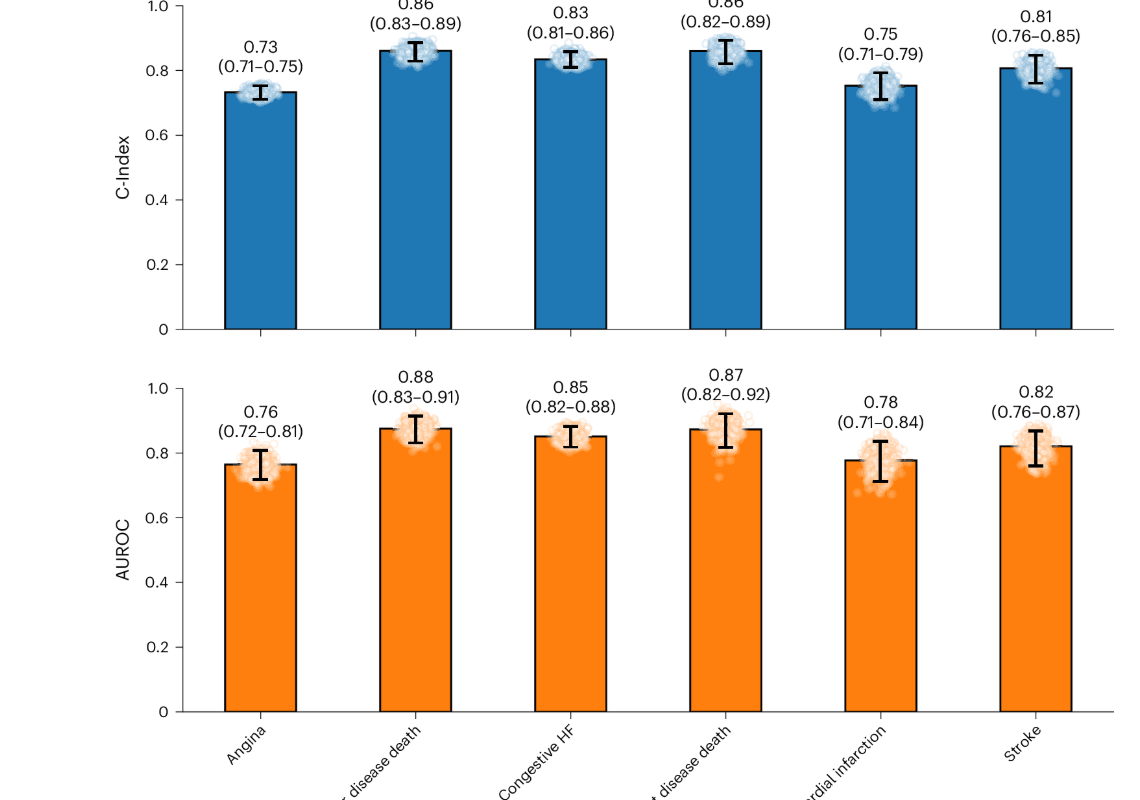
SleepFM’s predictive performance (C-index and AUROC) across cardiovascular outcomes over a six-year horizon. Source: Thapa et al., Nature Medicine.
What SleepFM actually does
A team at Stanford University, led by Professors Zou and Mignot, recently published in Nature Medicine the details of a novel AI model called SleepFM. The model analyzes sleep recordings to predict the future onset of over 130 disease conditions, ranging from dementia to stroke. In one example from the paper, the results cover several cardiovascular categories, with a prediction horizon of six years.
The scale of the training data is part of what makes this credible. SleepFM was trained on close to 600,000 hours of polysomnography (PSG) sleep recordings drawn from 65,000 subjects monitored across multiple clinics. That is a large and diverse foundation, and the researchers note that access to more data should raise the accuracy of predictions over time.
The goal here is not diagnosis for its own sake. It is to give physicians and patients enough lead time to take pre-emptive action—to delay, or even prevent, the onset of disease.
Why sleep is such a rich signal
Sleep is one of the few times the body runs through a long, repeatable cycle with the nervous system more or less on autopilot. Breathing, heart rate, brain activity, and oxygen levels all leave a trace across the night. To a model trained on enough examples, those traces carry information that a single daytime snapshot simply cannot.
This is also why we find the work so interesting at BreatheSimple. Many conditions that seem unrelated on the surface share a common root in how the central nervous system regulates breathing. The overnight record is, in part, a record of that control system at work—or struggling.
From clinic to wrist
The findings add credence to predictions our team recently made about the future role of wearables in healthcare. And we are not alone in this view. Members of the Stanford team see their project extending into wearables. With the latest Apple Watch models providing sleep apnea scores and ECGs, consumer devices are increasingly positioning themselves to advance toward disease risk screening.
There is an honest caveat here. SleepFM was trained on PSG data, which includes significantly more data feeds than today’s consumer wearables can capture. Dr. Chibuike Uwakwe, associated with Harvard and Stanford and a researcher in wearable bioelectronics, praised the team’s creativity in designing SleepFM’s complex architecture—and believes the technology could analyze wearable sleep data in the future, even if it cannot yet.
That gap between clinical-grade and consumer-grade data is exactly the space worth watching. It will not stay this wide.
Key takeaways
- What is SleepFM? An AI model from Stanford, published in Nature Medicine, that analyzes overnight sleep recordings to predict the future onset of over 130 conditions, with a six-year horizon in the published examples.
- How was it trained? On roughly 600,000 hours of clinical PSG recordings from 65,000 subjects across multiple clinics.
- Can my smartwatch do this today? No. The model relies on richer clinical data than current wearables collect, though researchers expect consumer devices to move in this direction.
- Why does it matter? Earlier risk signals give patients and physicians more time to act, shifting healthcare from reactive treatment toward prevention.
Where BreatheSimple fits
We are optimistic about a future where the data already streaming off your wrist—and your phone—gets turned into earlier, gentler nudges toward better health. BreatheSimple focuses on one underexplored corner of that picture: how your nervous system regulates breathing. Our free, patented screening uses your phone’s microphone to produce a Breathing Control Index in a few minutes.
BreatheSimple is not a medical device and does not diagnose or treat disease. But if a single night of sleep can hint at the years ahead, a few minutes of guided breathing is a reasonable place to start paying attention. Join the waitlist to try the screening and see where your breathing control stands.
Full study: Thapa, R., Kjaer, M.R., He, B. et al. A multimodal sleep foundation model for disease prediction, published in Nature Medicine (2026).