asthma and sleep apnea
Asthma and Sleep Apnea: The Hidden Overlap
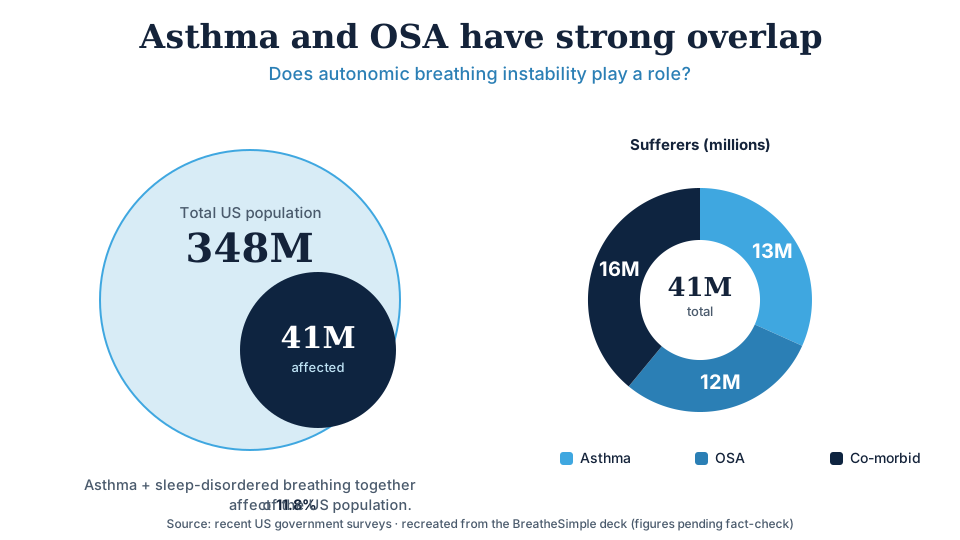
Asthma and obstructive sleep apnea frequently travel together, each making the other worse. A shared driver — unstable breathing control — may explain why.
If you have asthma and you also sleep badly, those two facts may be more connected than anyone has told you. A substantial body of clinical and epidemiologic research shows that asthma and obstructive sleep apnea (OSA) frequently coexist — and that each condition tends to make the other worse.
Asthma and sleep-disordered breathing overlap substantially — together they affect an estimated 11.8% of the US population. Recreated as an original chart from the BreatheSimple deck.
Two conditions that feed each other
The overlap is not subtle. Meta-analyses in both adults and children show that people with asthma have roughly 1.5 to 3 times higher odds of OSA or sleep-disordered breathing (SDB) compared with non-asthmatics. In studied cohorts, the prevalence of OSA among adults with asthma often approaches 35 to 50% (Kong et al., Nature, 2017).
The relationship appears to run both ways. OSA worsens asthma control, lung function, and the risk of exacerbations. Meanwhile, severe or poorly controlled asthma is associated with more severe OSA. They are not two separate problems that happen to share a patient — they amplify each other.
There is an encouraging flip side. Clinical studies show that treating OSA — whether with CPAP in adults or adenotonsillectomy in children — significantly improves asthma control. That suggests interventions aimed at sleep-disordered breathing may benefit both conditions at the same time.
A shared root cause: high loop gain
Why do these two travel together so often? Part of the answer may lie not in the airway’s anatomy but in how the brain controls breathing.
Over the last decade, researchers have established that high loop gain — where the brain’s autonomic breathing-control system overreacts to small changes in CO2 — is a major non-anatomical contributor to apnea events in roughly one-third of OSA patients (Eckert et al., J Physiol, 2013). When the control system is too twitchy, small fluctuations get amplified into instability: over-breathing, then under-breathing, then a pause.
The implication is significant. A meaningful subset of people who have both asthma and OSA may share ventilatory control instability as a treatable driver of their sleep-disordered breathing — independent of the traditional airway anatomy that CPAP is designed to address.
Where breath training comes in
If unstable breathing control is part of the problem, then training that control system becomes a reasonable thing to try.
- A meta-study on breath training and OSA suggests that breathing exercises can produce a measurable improvement in AHI for patients with mild to moderate OSA, alongside better sleep quality and less daytime sleepiness (Lopes et al., Sleep Breath, 2022).
- On the asthma side, there is significant clinical evidence that breath training designed to reduce breathing instability and curb episodes of hyperventilation can reduce the severity of asthma attacks for many patients.
An independent meta-study funded by the US Department of Health and Human Services put it plainly: “Hyperventilation reduction techniques can improve asthma symptoms or reduce reliever medication use over 6 to 12 months in adults with poorly controlled asthma.”
Our own preliminary work points in a complementary direction: breathing exercises derived from those that improve breathing stability — and shown to reduce asthma severity — may also help reduce SDB that stems from high loop gain.
Key takeaways
Are asthma and sleep apnea related? Yes. Research shows they frequently coexist, each raising the risk and severity of the other, and that treating one can improve the other.
What is loop gain? Loop gain describes how strongly your breathing-control system reacts to small changes in CO2. When it’s too high, the system overreacts, which can drive apnea events regardless of airway anatomy.
Can breathing exercises help? Studies suggest breath training may improve AHI in mild-to-moderate OSA and reduce asthma symptoms. Results vary by person, and breathing exercises are not a replacement for medical care.
Measuring the control system itself
The overlap between asthma and sleep apnea is one reason our team developed and patented a low-cost system to measure key parameters of ventilatory control instability. Based on the results, BreatheSimple offers personalized breath-training exercises designed to reduce the detected instabilities.
BreatheSimple is not a medical device and does not diagnose or treat asthma, sleep apnea, or any condition — always work with your clinician on those. But if you’ve never looked at your own breathing control, our free screening test is a simple, science-grounded place to begin.