sleep apnea breathing control
Beyond the Airway: The Other Cause of Sleep Apnea
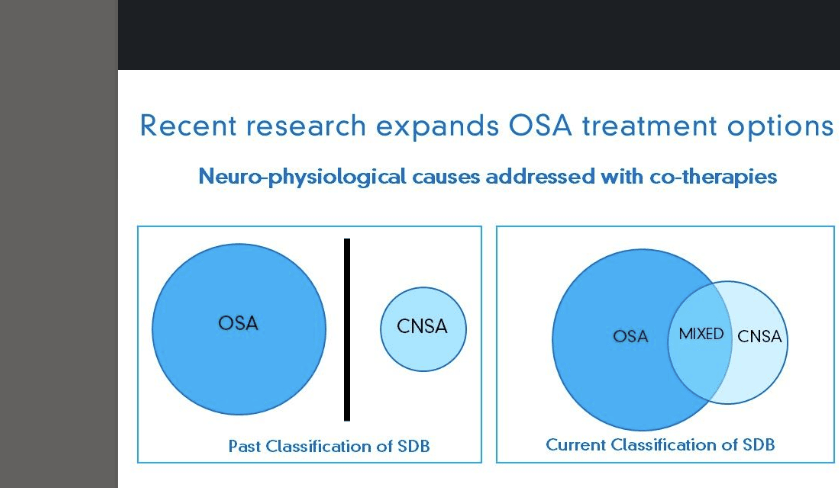
For decades, apnea care focused on keeping the airway open. A second cause — unstable breathing control in the brain — may matter in around 40% of cases.
For the last four decades, almost every sleep apnea management has been focused on keeping the upper airway open. CPAP masks, oral appliances, positional therapy, muscle training, implants, even surgery — different tools, same target.
It’s an effective strategy, and for many people it works. But it quietly ignores a second cause of apnea, one that lives not in the throat but in the brain.
How BreatheSimple frames sleep-disordered breathing: separating airway (OSA) from central or neuro-physiological (CNSA) causes, and the mixed phenotype that co-therapies target. Figure from the BreatheSimple research deck.
The other cause: unstable breathing control
Breathing isn’t something your conscious mind manages overnight. It’s run by control centers in the brainstem, constantly monitoring carbon dioxide and oxygen and adjusting your breathing to keep your whole metabolism in balance. When that control system is unstable, breathing can oscillate — surging and stalling — in ways that fragment sleep, even when the airway isn’t fully to blame.
For years, this mechanism sat in the background of apnea care. The airway got the attention; the controller did not.
Two causes, often entwined
What makes this especially important is that the two causes are not always separate. Research indicates that airway collapse and unstable breathing control may be intimately entwined in around 40% of cases.
In other words, for a substantial number of sufferers, treating just the airway addresses only part of the problem. The implication is clear: in a significant number of people, both causes should be treated in tandem.
Can you train the breathing control system?
If unstable breathing control is part of the picture, the natural question is whether it can be improved — not just managed mechanically each night, but actually retrained.
The approach here is neuroplastic training: working with the nervous system’s capacity to adapt, gradually nudging the breathing control system toward more stable behavior. Rather than overriding the controller from the outside, it aims to help recalibrate it.
We’ve developed a system to do exactly this, together with our London-based technology partner, Futurice.
A note on scope
To be clear, this is training, not a cure, and BreatheSimple is not a medical device — it doesn’t diagnose or treat disease. If you think you may have sleep apnea, the right next step is a conversation with a healthcare professional. Approaches like neuroplastic training are designed to complement clinical care, not replace it.
Key takeaways
What’s the “other” cause of sleep apnea? Beyond a collapsing airway, instability in the brain’s breathing control centers can disrupt breathing during sleep.
How often do both causes matter? Research suggests the two are closely entwined in around 40% of cases, meaning many patients may benefit from addressing both together.
Can the breathing control system be improved? Neuroplastic training aims to do this by working with the nervous system’s ability to adapt — a different approach from airway-focused devices.
Does this replace CPAP or other treatments? No. It’s a complementary approach for the neurological side of apnea, used alongside existing care.
Why this matters
The most interesting frontier in sleep apnea isn’t a better mask — it’s the realization that, for many people, the problem starts upstream, in how the brain regulates each breath. Treating the airway will always have its place. But for the roughly 40% of cases where breathing control is involved, looking beyond the airway opens up an entirely new set of options.
That’s the system BreatheSimple is built to measure and train. Our free, patented screening test offers a simple first look at how your own breathing control is performing — a few quiet minutes on your phone, no mask required.