breathing and the brain
Breathing and the Brain: A Conversation With RespireLab
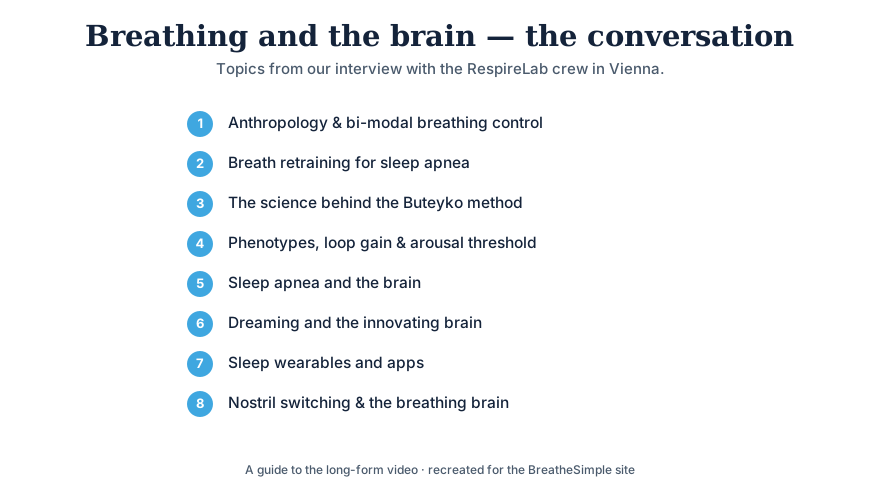
Notes from our wide-ranging conversation with the RespireLab team in Vienna on how the brain governs breathing — across sleep apnea, dreaming, and wearables.
We recently had the honor of sitting down with the RespireLab crew in Vienna for a long conversation about a subject we never tire of: how deeply the human brain is involved in human breathing — in every facet of our daily, and nightly, lives.
It’s a field with many deep furrows, and new ones are being plowed every day. Our conversation ran well past its intended length, and even after editing it remained generously long. So rather than try to compress everything here, we want to share the threads that came up and why each one matters. The views expressed were personal ones, offered in the spirit of starting a dialogue — and we fully expect some of you will disagree. Good.
A guide to the topics covered in our RespireLab conversation in Vienna — from the anthropology of breathing control to phenotypes, loop gain, and nostril switching.
Joining the dots: breathing is a brain story
The premise that animated the whole conversation is simple to state and surprisingly hard to internalize: breathing is not just a mechanical act of the lungs — it’s a control problem the brain is constantly solving. Once you see breathing as a regulated system rather than a bellows, a lot of seemingly unrelated conditions start to rhyme.
Bi-modal control and neuroplasticity
We opened with anthropology and bi-modal breathing control — the fact that breathing sits at an unusual junction, both automatic and voluntary. You don’t have to think about your next breath, but you can take over the controls at will. That dual nature is rare among bodily functions, and it’s precisely what makes breathing trainable. Where there’s voluntary access, there’s room for neuroplasticity — the brain’s capacity to rewire patterns with practice.
Retraining breath for sleep apnea
From there we moved to breath retraining for sleep apnea, and the perennially debated science around the Buteyko method. Our view is that the interesting question isn’t whether any single technique is a silver bullet — it rarely is — but whether deliberate breathing practice can shift the underlying control system over time. That’s a more modest and more testable claim, and it’s the one we find most promising.
Phenotypes, loop gain, and the arousal index
The heart of the discussion was the engineering of sleep-disordered breathing: phenotypes, loop gain, and the arousal index. Loop gain is a borrowed control-systems term, and it’s the concept we keep returning to. A breathing control system with high loop gain over-reacts to small changes in CO2 and O2 — it overshoots, then undershoots, and the result is instability through the night. Not everyone with apnea has the same underlying phenotype, which is exactly why one-size-fits-all treatment disappoints so often.
We also talked through sleep apnea and the brain more broadly — the ways disordered breathing and neural arousal feed each other in a loop that’s as much about the central nervous system as the airway.
Dreaming, wearables, and the body’s other signals
The conversation wandered, happily, into some of the field’s more speculative corners:
- Dreaming and the innovating brain — what sleep’s most vivid phase might be doing for cognition and creativity.
- Sleep wearables and apps — where consumer technology is genuinely useful today, and where the marketing has outrun the science.
- Nostril switching — the brain’s curious habit of alternating airflow between nostrils, and what it may signal.
- Wearables for blood-glucose tracking and diabetes management — a reminder that the same “dynamic microdata” trend reshaping sleep is reshaping metabolic health too.
That last thread connects to something we think about constantly: the arc of wearable sensing from heart rate, to heart-rate variability, to richer dynamic breathing microdata. Each generation captures a more telling signal about how the nervous system is actually behaving.
Key takeaways
Why treat breathing as a brain topic at all? Because the brainstem and central nervous system regulate the rhythm and depth of breathing. Many issues people experience as “airway” or “anxiety” problems share a root in how that control system behaves.
What is loop gain, in plain terms? It’s how reactive your breathing control system is. High loop gain means the system over-corrects to small shifts in blood gases, which can drive unstable breathing — particularly during sleep.
Is breathing trainable? Breathing’s dual automatic-and-voluntary nature gives you a handle on it, and the brain’s neuroplasticity means practice can shift patterns over time. These are personal views shared for discussion, not medical advice.
Where BreatheSimple fits
Conversations like this one are why we built BreatheSimple. The control system the RespireLab team and we spent an afternoon dissecting — loop gain, arousal, the brain’s grip on each breath — is exactly what our tools aim to measure and train. Our free, patented screening reads your breathing in a few minutes and produces a Breathing Control Index, a simple window onto that system.
If the ideas here resonate, join the waitlist and follow along as we keep building.
The views above were shared in a personal capacity. BreatheSimple is not a medical device and does not diagnose or treat any condition.