can breathing reduce anxiety
Can Breathing Reduce Anxiety?
Slow, conscious breathing lets you call on your parasympathetic nervous system to put the brakes on anxiety. Here's the science — and a simple way to practice.
Can breathing reduce anxiety? The short answer is yes — and here’s why.
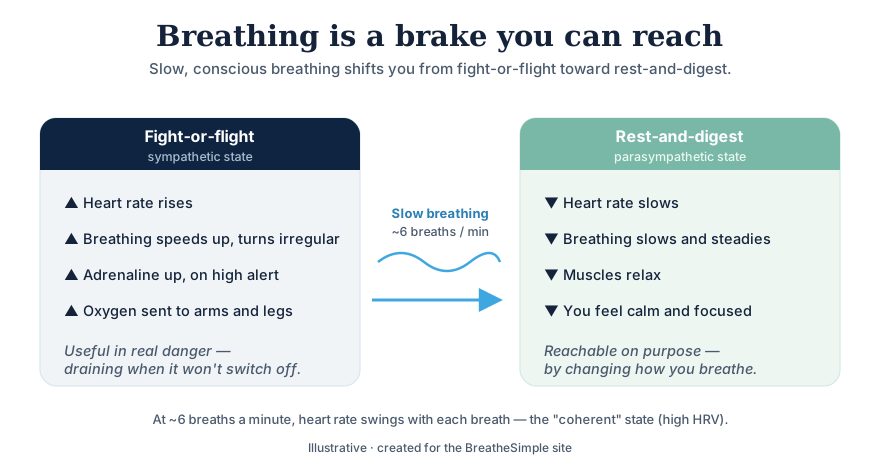
Slow, conscious breathing shifts you from fight-or-flight toward rest-and-digest. Illustrative.
We are all equipped with a complex central nervous system that works continuously in the background to keep our bodies functioning correctly across a wide range of conditions. When we exercise, the heart pumps faster to get more oxygen to our muscles, and our lungs work harder to get enough oxygen into the bloodstream. We may start to perspire to keep our temperature in a safe range. When we sleep or relax, heart and breathing rates slow down.
Two states, inherited from our ancestors
This nervous system has two natural states, inherited from our hunter-gatherer ancestors.
When we feel threatened, the sympathetic — the so-called fight-or-flight — state is triggered. Heart and breathing rates increase and become irregular, adrenaline rises, oxygen is directed to our arm and leg muscles, and we go on high alert.
When we feel safe and relaxed, the parasympathetic — the rest-and-digest — state comes into play. Heart and breathing rates decrease and stabilize, muscles relax, and we feel calm.
These two states are normally in balance: neither fully relaxed nor overly tense, so we can go about our daily lives comfortably.
When anxiety tips the balance
Now suppose that — for some reason, perhaps purely in our imagination — we become over-anxious. The fight-or-flight state is triggered: the heart races, breathing turns unstable, we may perspire, and we can’t focus. We may even tip into a full-blown panic attack and hyperventilate.
This is exactly when we can use breathing control to call on the parasympathetic state and put on the brakes.
How to use breathing to calm down
The most effective approach is to focus on your breathing and consciously slow it down with regular breaths. Holding the breath for a couple of seconds after each exhale can help, too.
We normally breathe in and out about 12–18 times a minute. If we can bring that down to around 6 breaths a minute, we enter what is called the coherent state — when heart rate swings strongly up and down with each breath, something known as heart-rate variability (HRV).
Practice when you’re calm
To get the best out of breathing for anxiety, practice slow, regular breathing daily — for a few minutes — when you are not feeling particularly anxious. Then, as soon as you notice anxiety starting to affect your heart and breathing, you’ll already have the tools to calm yourself before things get out of hand.
These techniques can be powerful. The US Department of Veterans Affairs teaches them to soldiers suffering from battlefield-induced post-traumatic stress disorder — a profoundly anxious state.
Where BreatheSimple fits
Learning to steady your breathing is a skill, and like any skill it rewards practice and feedback. BreatheSimple is built around exactly that: understanding how your nervous system regulates your breathing, and helping you train it toward steadier, calmer patterns.
BreatheSimple is a wellness and screening tool, not a medical device, and it does not diagnose or treat anxiety, panic disorder, PTSD, or any other condition. If anxiety is affecting your daily life, please talk with a qualified clinician. But as a daily practice, calmer breathing is one of the simplest tools you can carry with you.