CPAP compliance
The CPAP Compliance Problem — and a Gentler Alternative
Many sleep apnea patients struggle to stick with CPAP. We look at a peer-support trial that nudged compliance upward, and why less-invasive alternatives matter.
CPAP works. That’s not in dispute. The trouble is that the most effective treatment for sleep apnea is also one of the hardest to actually use — night after night, for years. The gap between a treatment’s efficacy and a patient’s willingness to stick with it has a name in medicine: compliance. And for CPAP, it’s a long-standing, stubborn problem.
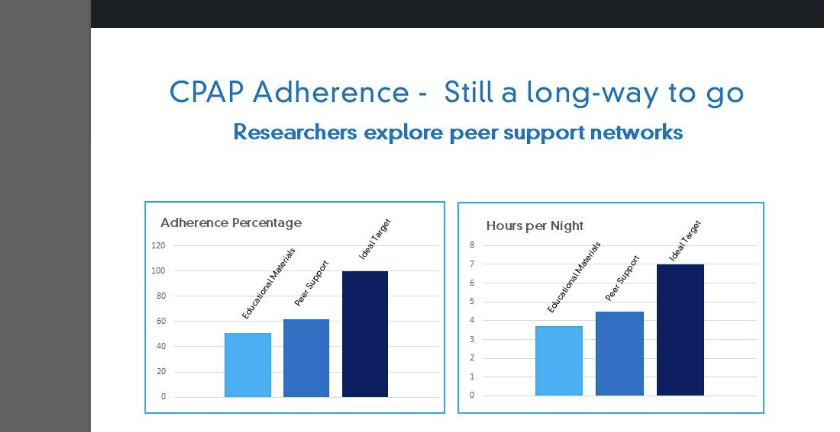
CPAP adherence improved with peer-support networks, both in correct use and average hours per night, but stayed below full compliance. Figure from the BreatheSimple deck, summarizing Parthasarathy et al.
Why insurers watch the clock
The compliance problem is so well known that it’s baked into how treatment gets paid for. Many insurers require patients to use their CPAP machine for four or more hours per night on at least 70% of nights within the first 90 days of therapy. That threshold isn’t arbitrary — it reflects studies showing that around four hours of nightly use is the point at which benefits begin to materialize.
The catch: many patients struggle to clear even that modest bar. So researchers keep hunting for ways to help people stay the course.
A peer-support experiment
One approach comes from a team led by Dr. Sairam Parthasarathy at the University of Arizona, who explored whether peer networks could change patient behavior around CPAP resistance. His framing of the problem is candid:
“The CPAP is the gold standard treatment for patients with sleep apnea. But the problem is that it’s a complicated external device that requires willpower by patients to put it on their faces. It requires a behavioral change, and that keeps many people from using it… watching videos or reading instruction manuals only gets you so far. But peer-driven intervention puts a personal touch on showing patients how to use the machine. It helps those with sleep apnea demystify CPAP and use it to their advantage.”
The trial enrolled 263 sleep apnea patients new to CPAP and ran for six months. Participants were randomly split into two groups:
- One group received usual care plus educational materials.
- The other group worked with trained peer mentors through in-person visits and phone calls.
What the numbers showed
The peer-support group came out ahead — but the gains were encouraging, not miraculous:
- 62% of patients receiving peer support used the machine correctly and consistently, compared with 51% in the education-only group.
- Average nightly use rose from about 3.7 hours (below the insurance target) to roughly 4.5 hours (just over it).
That improvement is real and clinically meaningful — it pushed the average over the threshold where cardiovascular benefit kicks in. But it’s worth being honest about the ceiling: even with mentoring, the group landed well short of full compliance. Peer support helps; it doesn’t solve.
In short, there’s still a long way to go before most patients reliably get the full benefit of their masks.
A different angle: reduce the dependence
Most compliance research asks the same question — how do we get people to wear the mask more? Our team has been working on a different question: can we reduce how much some people need the mask in the first place?
We’re developing less-invasive combinatorial therapies aimed at the underlying breathing-control instability that drives apnea. For up to 40% of patients diagnosed with mild or moderate apnea, this approach may enable a gradual decline in dependence on CPAP devices over time — easing the burden of strict, long-term nightly compliance, and in some cases perhaps even reducing the need for nightly use altogether.
To be clear, CPAP remains the gold standard for many people, and this is not a replacement for medical care. It’s an attempt to widen the menu — especially for the milder end of the spectrum, where the mask’s burden can feel disproportionate to the disease.
Key takeaways
What counts as “compliant” CPAP use? A common insurer standard is at least four hours of use on 70% of nights during the first 90 days — the level at which cardiovascular benefits begin to appear.
Does peer support actually help? In the University of Arizona trial, it raised consistent correct use from 51% to 62% and lifted average nightly use from about 3.7 to 4.5 hours. A meaningful gain, but still short of full compliance.
Is there an alternative to CPAP? For some people with mild or moderate apnea, less-invasive combinatorial approaches that target breathing-control instability may reduce dependence on the machine over time. Any change to apnea treatment should be made with a clinician.
Where BreatheSimple fits
Apnea, at its root, is often a breathing-control problem — the nervous system over-reacting to small shifts in blood gases through the night. That’s exactly the system BreatheSimple is built to measure and train. Our free, patented screening reads your breathing in a few minutes and produces a Breathing Control Index, and our guided programs are designed to train that control over time.
If the mask has been a battle, it’s worth understanding the system underneath it. Join the waitlist to try the screening, and follow our work on gentler alternatives.
Source: peer-support CPAP trial led by Dr. Sairam Parthasarathy, University of Arizona. BreatheSimple is not a medical device and does not diagnose or treat any condition.