sleep deprivation attention lapses
Microsleeps: When Your Brain Cleans House During the Day
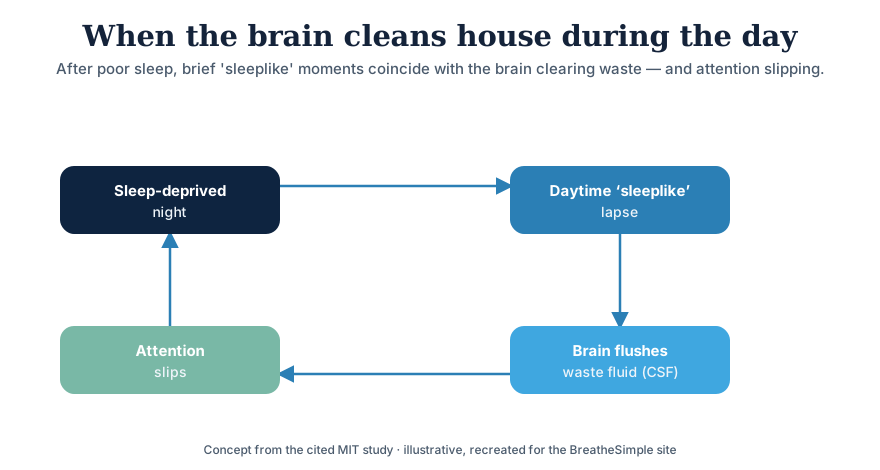
New MIT research suggests the attention lapses that follow a sleepless night are the brain trying to clean itself — flushing out waste it usually clears overnight.
You know the feeling after a sleepless night: you are awake, eyes open, and yet the outside world briefly stops landing. New research suggests those daytime lapses are not just fatigue. They may be your brain trying to do its overnight cleaning during the day, whether you like it or not.
After a poor night, brief sleeplike daytime moments coincide with the brain clearing waste fluid — and attention slipping. Illustrative concept from the cited MIT study.
What the MIT team studied
Recent research by a team from MIT, led by Professor Laura Lewis, explores sleeplike states that show up during the day after a sleep-deprived night. We have long known that poor sleep produces lapses in attention. The new work asks why — and points to housekeeping.
During sleep, the brain flushes out waste that accumulates during waking hours. The MIT findings suggest that when you skip that overnight cleaning, the process does not simply wait politely. It intrudes on your day, and each intrusion comes at the cost of your attention.
How they tested it
The team studied 26 participants, each tested twice: once well-rested, and once after staying awake all night. During the daytime tests, an fMRI scan tracked the movement of cerebrospinal fluid (CSF) out of the brain while participants worked through attention tasks and a range of physiological signals were monitored.
The pattern was telling. Sleep-deprived participants had slower reactions when awake, and those slow moments coincided with a burst of CSF flowing out of the brain. At the same time, physiological factors shifted in step — heart rate, respiratory rate, and even pupil diameter varied alongside the lapses.
In Professor Lewis’s words: “It’s this kind of very sleeplike moment, the person is awake, but at the same time, there’s clearly this brief breakdown of ability to focus on the outside world.”
Why this should worry the chronically tired
This research adds yet another reason to take adequate sleep seriously — and this one has real-world stakes. It is already known that inadequate sleep raises the chance of daytime accidents. The MIT findings give that risk a mechanism.
A lapse in attention caused by the brain quietly repairing itself is harmless at your desk. Behind the wheel on the morning commute, it can be fatal. The unsettling part is that these moments are not fully under conscious control. You cannot reliably power through a process your brain is determined to run.
The breathing connection
Notice which signals moved during those lapses: heart rate, respiration, pupil size. These are all governed by the same autonomic systems that regulate breathing — a reminder that brain state, breathing, and attention are deeply intertwined. The quality of the sleep that prevents these daytime intrusions depends in part on how steadily your nervous system manages breathing through the night.
Key takeaways
- Daytime attention lapses after poor sleep may be the brain cleaning itself, flushing out waste it normally clears overnight.
- These lapses coincided with bursts of cerebrospinal fluid leaving the brain, plus shifts in heart rate, breathing, and pupil size.
- They carry real risk, especially during driving, because they are sleeplike and not fully under conscious control.
Quick questions
What is a microsleep, in plain terms? A brief, sleeplike moment while you are technically awake — your eyes are open but your ability to register the outside world drops out for a beat. This research suggests it may accompany the brain’s waste-clearing process.
Can I just push through them? Not reliably. Because the underlying process is physiological, the safest response to heavy sleep deprivation is to avoid high-stakes tasks like driving — not to fight the lapses with willpower.
Why do heart rate and breathing change during these moments? They are controlled by the same autonomic systems that shift as the brain moves between focused and sleeplike states, which is why several signals move together.
The bottom line
Attention is not infinite, and after a bad night your brain may start reclaiming time for maintenance it could not finish overnight. The lesson is old but the evidence is fresh: protect your sleep, and you protect your focus where it matters most.
Better sleep starts with understanding the systems behind it. BreatheSimple’s free, patented screening uses your phone’s microphone to produce a Breathing Control Index in minutes — a first look at how your nervous system regulates breathing while you rest. BreatheSimple is not a medical device and does not diagnose or treat any condition, but it is a calm place to begin paying attention to how you sleep, so your brain can finish its housekeeping at night.