heart rate variability during sleep
Beyond HRV: What Night-to-Night Swings Reveal
A WHOOP study of two million nights argues that the night-to-night swing in your HRV — not just the average — may be the more revealing health signal.
It has become fashionable to obsess over heart rate variability (HRV) — generally on the assumption that higher is better. But there may be more hidden in the details than a single nightly number can show. The interesting signal might not be your HRV at all. It might be how much your HRV moves.
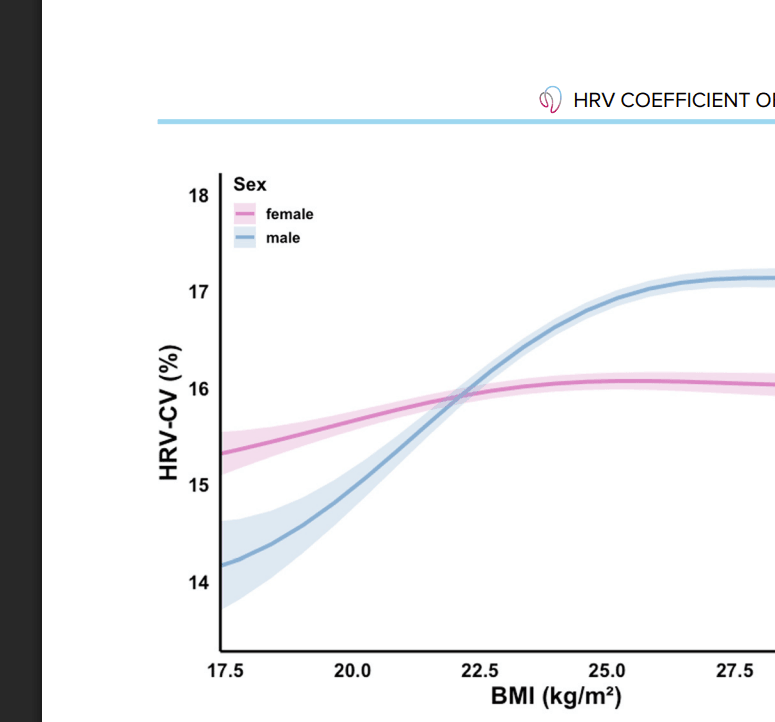
Heart-rate-variability coefficient of variation (HRV-CV) as a digital biomarker, by sex across BMI. Source: the WHOOP research report cited in this post.
A second look at a familiar number
A large study led by researchers at WHOOP in Boston suggests there is real value in checking how, and when, HRV scores vary across the night. The team introduces what is essentially a second derivative of heart rate — the variability of heart rate variability, referred to as HRV-CV — to quantify day-to-day swings in cardiac autonomic activity.
If your average HRV is a snapshot, HRV-CV is closer to a measure of how stable that snapshot is from one night to the next. Two people can share an identical average and live in completely different physiological worlds: one steady, one swinging.
What the data showed
The analysis drew on two million nights of sleep data from more than 21,000 adults. Remarkably, a useful HRV-CV value could be derived from just seven nights of data. That short window tracked with a familiar list of factors:
- Erratic, inconsistent sleep
- Higher alcohol consumption
- Less daytime movement
- Higher body weight (BMI)
In other words, a high HRV-CV — lots of swing — tended to travel alongside the behaviors and conditions we already associate with poorer health.
Why the swing matters
A single great HRV reading is easy to celebrate and easy to misread. The night-to-night swing is harder to fake. The WHOOP team argues that HRV-CV should be added to consumer sleep trackers so that more value can be extracted from the raw heart rate sensors already sitting on millions of wrists.
The appeal is practical. By cross-correlating HRV-CV with personal factors — alcohol, lower daytime activity, shorter and less consistent sleep, age, and BMI — a tracker could move from describing your night to suggesting why it went the way it did, and personalize lifestyle recommendations accordingly.
This fits a broader arc in wearables: from heart rate, to HRV, to richer dynamic signals pulled from the same sensors. The hardware on your wrist has been under-sampled. The opportunity now is software that asks better questions of the data it already collects.
How breathing fits in
Heart rate variations during sleep can be put to other uses, too. As one example, our team at BreatheSimple uses this kind of parameter to screen for apnea events — a patented approach to spotting the signatures of disrupted breathing in the night’s signal. Pairing that capability with a measure like HRV-CV could make a tracker more informative still, layering how you breathe on top of how steady your autonomic system is.
It also reinforces a theme we keep returning to: much of what disrupts sleep traces back to how the central nervous system regulates breathing. The same control system that drives breathing instability leaves fingerprints on the heart rate record — which is exactly why these sleep-time signals are worth mining.
Key takeaways
- Average HRV is only part of the picture. The night-to-night swing — HRV-CV — may carry distinct information.
- It is derivable quickly. In this study, just seven nights produced a meaningful HRV-CV value.
- High swing tracked with risk factors: erratic sleep, more alcohol, less movement, higher BMI.
- The same heart rate signal can screen for breathing disruption, including apnea-like events.
Quick questions
I already have HRV data from sleep. What can I do with it? Look at how much it swings from night to night, not just the average. That spread can tell you more about your health than any single reading. The charts in the full WHOOP report can help you interpret your own numbers.
Is a high HRV-CV automatically bad? Not on its own — it is a flag, not a diagnosis. It is most useful read alongside context like recent drinking, activity, and sleep consistency.
The bottom line
Stop staring at last night’s HRV in isolation. The more honest signal is the wobble — how much that number drifts across a week. If you already have legacy HRV data collected during sleep, check the swing.
BreatheSimple is built to turn everyday sensor data into something you can act on. Our free, patented screening uses your phone’s microphone to gauge how your nervous system regulates breathing, producing a Breathing Control Index in minutes. BreatheSimple is not a medical device and does not diagnose or treat any condition — but it is a thoughtful first step toward understanding the systems behind your numbers.