how the brain controls breathing
How Your Brain Controls Every Breath You Take
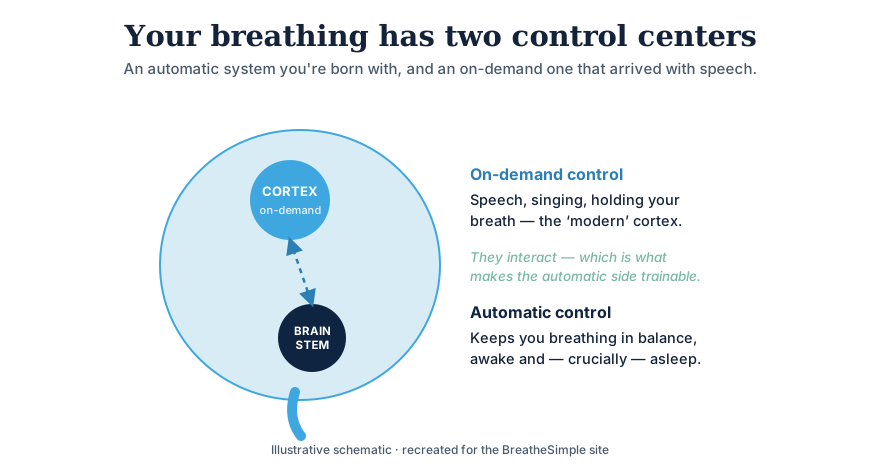
Your breathing runs on two control systems — one automatic, one voluntary. Understanding how they interact may be the key to training more stable sleep breathing.
You take roughly 20,000 breaths a day, and you consciously decide on almost none of them. Yet you can also hold your breath, sing a phrase, or push through one of those famously long German sentences entirely on purpose. That dual nature — automatic by default, voluntary on demand — is one of the more elegant features of the human nervous system, and it turns out to matter a great deal for how well you sleep.
Breathing runs on two interacting control centers: an automatic system at the brainstem and an on-demand one in the cortex. Their interaction is what makes the automatic side trainable. Illustrative schematic.
Two control centers, one set of lungs
Most of the time, your breathing is managed for you. Specialized regions near the brain stem continuously adjust the timing and depth of each breath to keep your body in balance — when you are awake, when you exercise, when you dive, and, most critically, while you sleep. You never think about it, which is the whole point.
But humans have a second system layered on top. Anthropologists believe our ancestors began developing language more than 100,000 years ago, and that shift required physical changes in the mouth, tongue, pharynx, and larynx — along with neuro-physiological changes in the brain. As language grew more complex, breathing control had to evolve with it. A volitional control center developed in the cortex, giving us deliberate command over the breath. That is what lets you hold your breath on cue or pace your exhale to finish a sentence.
So you have two systems sharing the same lungs:
- Autonomous control near the brain stem — always on, keeping you balanced and alive.
- Cortical (voluntary) control — switched in when you choose to override the automatic rhythm.
Watch the handoff happen during speech
Speech is one of the clearest places to see these two systems trade off. Before you say anything, your breathing usually sits in a steady, relaxed state. Just before you begin to talk, you quietly take in some extra air — an extended inhale to stock up, because you only produce speech on the exhale and you need the reserve.
At that exact moment, brain imaging shows the cortex “light up” as control shifts away from the relaxed automatic state. As you keep talking, your breathing varies in timing and depth, falling into sync with the structure of your thoughts and sentences rather than the steady metronome of rest. Then, when you stop, autonomous control takes over fully again and the cortex quiets down.
It is a small, constant negotiation most of us never notice — the voluntary system stepping in, doing its job, and stepping back out.
Why this matters for disturbed sleep
Here is the part that gets interesting for anyone who struggles with sleep. The two control centers are not sealed off from each other — they interact. The exact mechanisms are not yet fully understood. But that intra-brain connection opens a door: if the voluntary system can influence the automatic one, then neuroplasticity-based methods may be able to “train” the autonomous control to reduce some of the instabilities behind sleep-disordered breathing (SDB).
In other words, the deliberate, cortical side of breathing might be used as a lever to nudge the automatic side toward steadier behavior overnight — when you are no longer awake to manage anything yourself. This is a training idea, not a cure, and breathing patterns vary from person to person. But the underlying logic is grounded in how the nervous system is actually wired.
Key takeaways
Do I control my own breathing? Partly. Most breathing is handled automatically by regions near the brain stem, but a separate voluntary center in the cortex lets you override it on demand — to speak, sing, or hold your breath.
Why does my breathing change when I talk? Speech shifts control from the automatic system to the cortex. You inhale a little extra before speaking, then vary your breath to match your sentences, because speech happens on the exhale.
Can breathing be trained to improve sleep? The two control systems interact, which suggests the voluntary system may be used to help train the automatic one toward more stable breathing. Research in this area is ongoing.
Bringing the science to your sleep
Understanding this two-system architecture has been the focus of our team’s research for years. BreatheSimple is built around measuring and training the breathing-control system that sits at the root of so much sleep disturbance. It is not a medical device and does not diagnose or treat any condition, but it can help you understand your own breathing.
Curious where your breathing control stands? Our free, patented screening test takes just a few minutes — a simple place to start.