irregular bedtime heart risk
Your Bedtime Might Matter More Than Your Diet
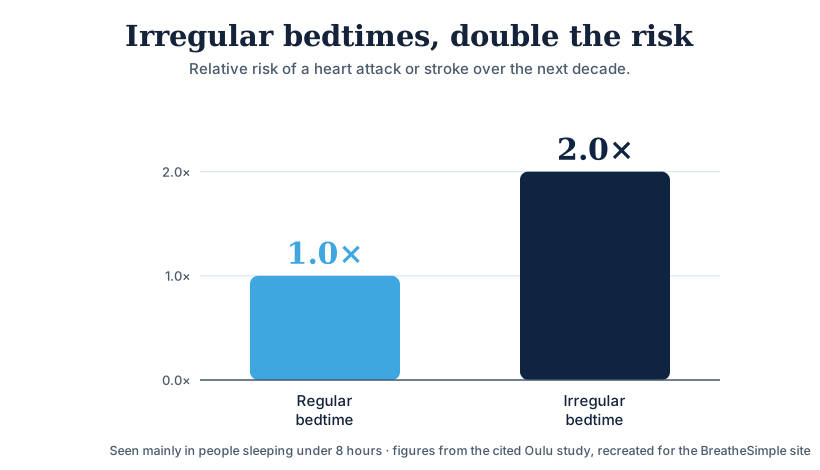
A large Finnish study suggests that when you go to bed may matter as much as what you eat — irregular bedtimes were tied to nearly double the cardiovascular risk.
Choosing your bedtime might be more important than choosing your dinner. That is the uncomfortable takeaway from recent data published in the peer-reviewed journal BMC Cardiovascular Disorders — and it has nothing to do with how many hours you actually sleep.
Irregular bedtimes were associated with roughly double the risk of a heart attack or stroke over the next decade — mainly in people sleeping under 8 hours. Recreated from the cited study.
What the study found
A team led by Professor Vahid Farrahi at the University of Oulu in Finland followed 3,231 adults from age 46 onward. The researchers were not asking the usual question — how much do you sleep? — but a subtler one: how consistent is your schedule?
The answer was striking. Adults who went to bed at wildly different times each night — even by just an hour or two — had nearly twice the risk of a heart attack or stroke over the following decade.
The effect held up across two groups: people who spent below-average time in bed and people who spent more time than average. In both cases, irregularity raised the likelihood of a cardiovascular event, irrespective of total time spent sleeping. In other words, you do not get to “make up” for a chaotic schedule by simply logging more hours.
Bedtime, not wake time
One detail stands out. Wake-up time did not appear to matter much. Bedtime did. Your morning alarm may be negotiable; the hour you actually fall asleep is not.
There was also a catch worth noting. This substantial risk showed up mainly in people sleeping fewer than eight hours. That is an awkward finding, because it implies irregular bedtimes are most dangerous for exactly the people most likely to have them — busy professionals burning the candle at both ends.
Why timing matters to your heart
Your cardiovascular system runs on a clock. Blood pressure, heart rate, and hormone release all follow a roughly 24-hour rhythm orchestrated by your internal Circadian timing. When you shift your bedtime around night to night, you are effectively asking that clock to keep resetting itself.
Confuse the clock, and you pay for it. The body never settles into the predictable nightly pattern of recovery it is built to expect, and over years that instability appears to add up — at least according to this dataset.
At BreatheSimple, we focus mostly on how you sleep — how the upper airway can malfunction, how different neurophysiological phenotypes influence breathing instability, and how anxiety feeds nighttime restlessness. This study is a useful reminder that when you sleep is part of the same picture. The control systems that govern breathing and the clock that governs cardiovascular rhythm both reward consistency.
Key takeaways
- Irregular bedtimes were tied to nearly double the risk of heart attack or stroke over a decade in this study, independent of total sleep duration.
- Bedtime mattered more than wake time. A steady “lights out” hour appears to be the lever worth pulling.
- The risk concentrated in shorter sleepers — under eight hours — the very people most prone to erratic schedules.
Frequently asked questions
Does this mean sleep duration does not matter? No. Duration still matters — the elevated risk was clearest in people sleeping under eight hours. The point is that consistency is a separate factor on top of duration, not a replacement for it.
What is a simple first step? Try to answer this: what time did you go to bed last night, and the night before? If you cannot answer within 30 minutes, that variability is the place to start. Pick a bedtime and defend it like a meeting with your most important client — because the client is you.
Is an occasional late night a problem? A single late night is not what this research is about. The concern is chronic, week-after-week irregularity. The goal is a reliable average, not perfection.
The bottom line
You can optimize your diet and your workouts all you like, but if your bedtime swings by hours from one night to the next, you may be undermining the very system you are trying to protect. Pick a time. Hold the line.
BreatheSimple is built around the idea that better sleep starts with understanding your own physiology. Our free, patented screening uses your phone’s microphone to produce a Breathing Control Index in a few minutes — a simple first look at how your nervous system regulates breathing while you rest. BreatheSimple is not a medical device and does not diagnose or treat any condition, but it is a calm place to start paying closer attention to how you sleep.