loop gain sleep apnea phenotype
Measuring Loop Gain: A New Patent for Sleep Apnea Phenotyping
Sleep apnea has more than one cause. A newly awarded patent covers low-cost ways to measure loop gain, a key phenotype, using existing wearables and devices.
For decades, sleep apnea was treated as a plumbing problem: the airway collapses, so prop it open. That picture is real, but it’s incomplete — and a newly awarded patent reflects how much the science has moved on.
We’re glad to share that our international team has been granted an important patent in the field of sleep apnea detection and alleviation. It focuses on something most people have never heard of but that matters enormously for treatment: loop gain.
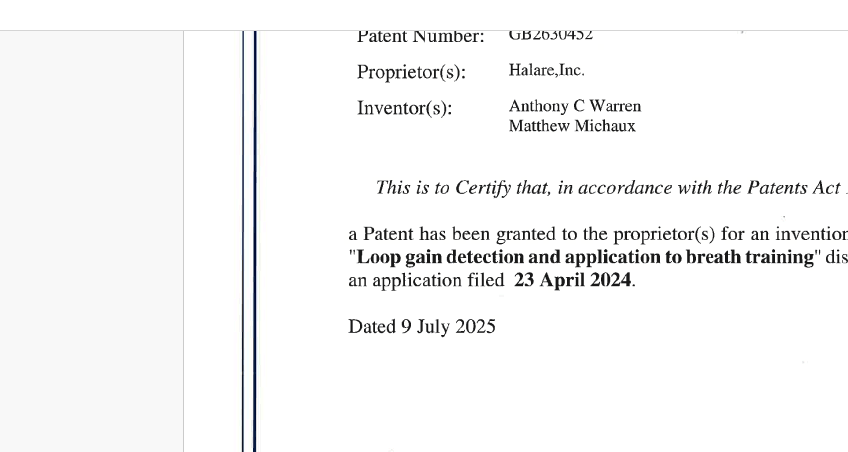
The granted UK patent, “Loop gain detection and application to breath training” (filed 23 April 2024). UK Intellectual Property Office certificate.
Apnea has more than one cause
It is now generally accepted that obstructive sleep apnea (OSA) involves more than just poor airway patency. Neurological triggers play a role in roughly 40% of patients — meaning that, for a large share of people, keeping the airway open is only part of the answer.
To prescribe the right therapy, clinicians increasingly classify patients into phenotypes: descriptions of why a particular person’s breathing destabilizes during sleep. Different phenotypes often call for different — and sometimes combined — treatment regimens. Two patients with the same apnea score can need very different care.
What is loop gain?
Your body runs breathing through a feedback loop. Sensors track carbon dioxide and oxygen, and the brainstem adjusts how hard and fast you breathe to keep them in balance.
Loop gain describes how aggressively that control system reacts. When loop gain is high, the system over-responds to small changes in CO₂ or O₂ — overcorrecting, then overcorrecting again. The result is unstable, oscillating breathing that can drive pauses and arousals through the night, even when the airway itself isn’t the whole story.
A related phenotype parameter is the arousal threshold — essentially, how easily you wake from a breathing disturbance. A low arousal threshold can mean a person wakes at the slightest interruption, fragmenting sleep before the body has a chance to settle.
What the patent covers
The challenge with phenotyping has always been measurement. Quantifying loop gain has traditionally required specialized sleep-lab equipment, putting it out of reach for routine use.
Our team has developed low-cost methods for quantifying two key phenotype parameters — high loop gain and low arousal threshold. This particular patent focuses on high loop gain. Additional patents covering further techniques for both loop gain and arousal threshold, combined with indicated therapeutic protocols, have been filed internationally, and we expect them to be granted shortly.
Crucially, these techniques are designed to be practical. They can be:
- implemented using existing wearables,
- seamlessly integrated into existing home sleep apnea test (HSAT) devices, or
- built into CPAP masks.
In other words, the goal is to make phenotyping something that can happen with hardware many people already use, rather than only in a specialized lab.
We’d also like to thank the US Department of Health and Human Services for contributing funds toward this program.
Why phenotyping matters
Moving from “you have apnea” to “you have this kind of apnea” is a meaningful advance. It opens the door to therapies matched to the actual mechanism — and to combination approaches when more than one mechanism is in play.
Key takeaways
Is sleep apnea only about the airway? No. Research suggests neurological triggers contribute in roughly 40% of patients, which is why phenotyping beyond airway anatomy matters.
What is loop gain? It’s a measure of how strongly your breathing control system reacts to changes in CO₂ and O₂. High loop gain means the system overreacts, producing unstable breathing.
What does the new patent do? It covers low-cost methods for quantifying high loop gain — a key phenotype parameter — using existing wearables, HSAT devices, or CPAP masks.
Will this diagnose my apnea? On its own, no. Phenotyping is a tool to help clinicians personalize care. If you suspect sleep apnea, that’s a conversation to have with a healthcare professional.
Where this fits
Better measurement is the quiet engine behind better treatment. By making loop gain measurable outside the lab, this work helps move sleep medicine toward therapies tailored to the individual.
That’s the same control system BreatheSimple is built around. Our free, patented screening test measures your breathing control through a short guided session on your phone — a simple first look at how your own system is tuned.