oversleeping and dementia risk
Can Oversleeping Be an Early Warning for Dementia?
A new study links habitual long sleep to faster cognitive decline. We explore why oversleeping may be an early, possibly reversible marker of dementia risk.
Most sleep advice is about getting enough. But a growing body of research suggests the question is more subtle: what if sleeping too much is itself a warning sign — not of laziness, but of something happening inside the brain?
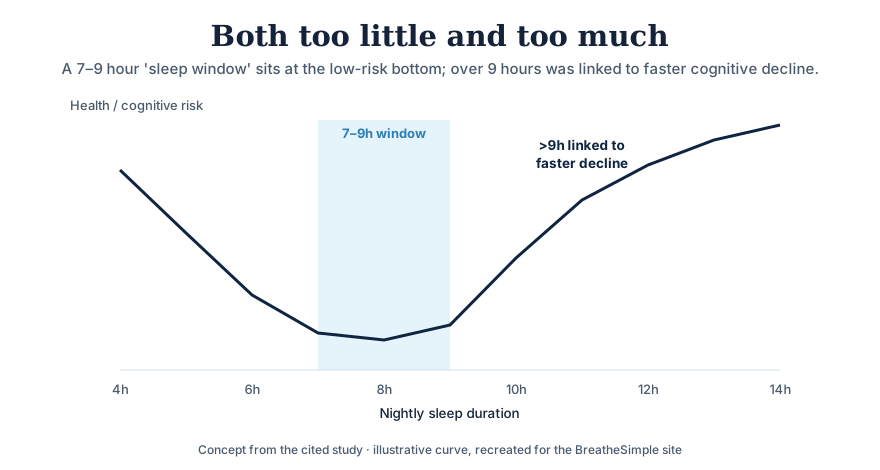
The familiar “sleep window” of 7–9 hours has long rested on statistical evidence that both too little and too much sleep track with long-term health problems. A recent study takes a closer look at the upper end of that window and asks a pointed question about over-sleeping and brain function.
Risk is lowest in the 7–9 hour sleep window and rises at both ends; sleeping over 9 hours was linked to faster cognitive decline. Illustrative curve based on the cited study.
What the study found
A team led by Dr. Vanessa Young at the Biggs Institute for Alzheimer’s and Neurodegenerative Diseases at the University of Texas, San Antonio examined long-term health records of more than 1,800 participants who were free of dementia and stroke at the start. Their average age was around 50 — middle-aged, not elderly.
The findings are worth pausing on:
- Sleeping more than 9 hours nightly was associated with an increase in cognitive decline.
- The effect was amplified in people with depression — and that held true whether or not they were taking anti-depressants.
In other words, long sleep wasn’t a neutral habit in this data. It traveled alongside measurable changes in cognition, and it traveled hardest in people already carrying a mood burden.
The chicken-and-egg problem with depression
If oversleeping and depression move together, which one is driving the other? The research is honest about the ambiguity. As the authors put it:
“The reciprocal association between sleep disturbances and depression may create a cycle in which disrupted sleep exacerbates depressed symptoms, which in turn influences sleep quality. Sleep disturbance may increase vulnerability to depression by altering neural sensitivity to inflammation and disrupting neurotransmitter systems… conversely, depressive symptoms can disrupt sleep due to factors like worrying and difficulty coping with stress.”
That is the loop. Disrupted sleep may prime the brain for depression through inflammation and neurotransmitter changes; depression, in turn, can erode sleep through rumination and stress. Untangling cause from effect is genuinely hard, and the study doesn’t pretend otherwise.
Why this matters: a marker, not a verdict
The most interesting takeaway is also the most hopeful one. The data suggests that persistent over-sleeping may be an early — and potentially reversible — biological marker of neurodegeneration, and a risk factor for dementia onset later in life.
“Early” and “reversible” are the operative words. A marker that shows up years before symptoms is exactly the kind of signal worth catching, because it opens a window for intervention rather than just a diagnosis after the fact.
This is where the wearable revolution becomes interesting. As sleep-tracking devices and apps become routine, detecting persistent long-sleeping over weeks and months becomes trivial in a way it never was in a clinic. Pair that passive signal with a standard cognitive questionnaire, and you have the rough outline of an early-warning system — one that could nudge someone toward assessment and, where appropriate, early intervention therapy.
To be clear, no app and no wearable diagnoses dementia. Long sleep is a correlate, not a verdict, and most people who sleep nine-plus hours will be perfectly fine. The value is at the population level: a cheap, passive signal that helps decide who might benefit from a closer look.
Key takeaways
Is sleeping more than 9 hours a night bad for me? Not necessarily on any given night. But habitually sleeping more than nine hours was associated with faster cognitive decline in this study — especially for people with depression. It’s a pattern worth noticing, not a single night worth worrying about.
Does oversleeping cause dementia? The research doesn’t establish cause. It found an association and suggests over-sleeping may be an early, possibly reversible marker of neurodegeneration — which is different from saying it causes disease.
What should I do if I notice I’m sleeping a lot? Persistent changes in sleep duration — in either direction — are worth raising with a clinician, particularly alongside low mood. Wearable data can help you see the pattern clearly before you bring it up.
Where BreatheSimple fits
We’re builders of breathing-focused tools, not dementia screeners — but we care deeply about the same underlying idea: that small, passive, everyday signals from your phone and wearables can surface health risks long before they announce themselves. BreatheSimple’s free, patented breathing screening turns your phone’s microphone into a quick window on how your nervous system regulates breathing, and our roadmap points toward passive overnight sleep-instability measurement.
If you’re curious what a few minutes of guided breathing can reveal, join the waitlist to be among the first to try it.
Source: study reported in the Journal of Alzheimer’s & Dementia (doi:10.1002/alz.70160). BreatheSimple is not a medical device and does not diagnose or treat any condition.