treatment adherence wearables
Why Half of Patients Don't Follow Treatment — and How Wearables Can Help
About half of patients don't take treatment as prescribed. We look at why adherence is so hard, and how wearables can match therapy to real behavior.
Every physician knows the quiet frustration. You write a prescription, explain it carefully, and then hope. Will she take the antibiotics for the full ten days? Will he wear his CPAP mask for at least four hours a night, or insert his oral appliance most evenings? Will she keep up the rehab exercises for the full six months after a stroke?
Often, the answer is no. And the scale of the problem is larger than most people assume.
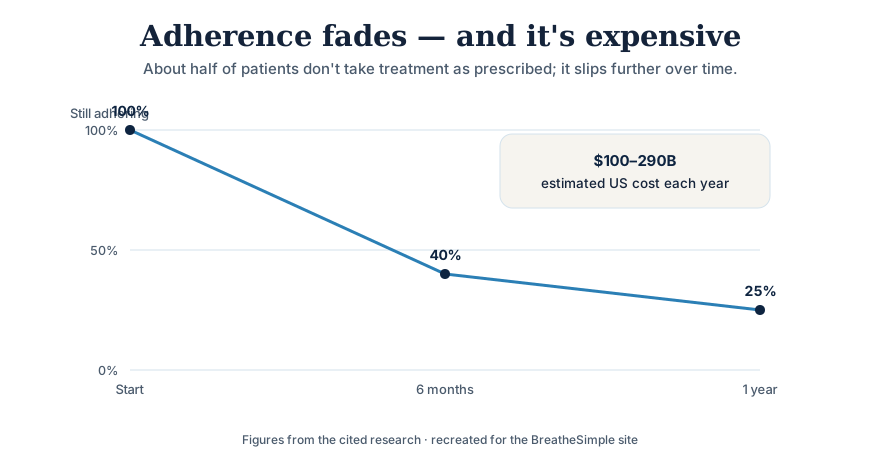
Adherence to long-term treatment fades over time — and non-adherence is estimated to cost the US $100–290B a year. Figures from the cited research; recreated chart.
The adherence gap is bigger than you think
Research shows that roughly 50% of patients do not take their medications as prescribed. For long-term and chronic treatments, adherence is even worse — some studies report non-compliance rates of around 60% at six months and as high as 75% at one year.
The reasons are varied and complex. They involve the patient, the disease, the treatment itself, and the healthcare system around it. Side effects, cost, forgetfulness, complicated regimens, low motivation, and simple disbelief that the treatment is working all play a part. There is rarely a single villain.
The consequences add up quickly. Non-adherence drives more medical visits and more intensive care later on. By one estimate, it costs the United States alone somewhere between $100 billion and $290 billion every year.
The trust problem
Every patient is different. Some follow instructions to the letter; others improvise, skip doses, or quietly give up. And here’s the uncomfortable part: can patients even be trusted to report what they actually did? Self-reported adherence tends to be optimistic. People remember the nights they wore the mask, not the ones they didn’t.
That gap — between what’s prescribed, what’s done, and what’s reported — is exactly where objective measurement can help.
Where wearables come in
This is the problem our international team has been working on, and the subject of a newly awarded patent in the field of healthcare management. The core idea is straightforward: instead of treating every patient with the same one-size-fits-all protocol, use a wearable to match individual behavioral traits to a therapeutic pathway.
Rather than asking a patient to immediately meet an ideal target, the approach tracks what they actually do and adjusts the plan to fit them — meeting people where they are, then nudging forward.
As one worked example, consider a somewhat reluctant patient with sleep apnea. Our patented method uses a wearable to observe the patient’s tracked behavioral patterns and then steps them through four tailored stages, each matched to where they are rather than where the textbook says they should be.
The trade-off is honest: when therapy bends to fit a person’s lifestyle and personality, the desired outcome may take a little longer to reach. But a slower path that the patient actually stays on beats an optimal protocol they abandon in week two.
A note on what this is — and isn’t
To be clear, this is about supporting adherence, not diagnosing or treating disease on its own. BreatheSimple is a breathing analysis and training app, not a medical device, and approaches like this are designed to work alongside clinical care — giving clinicians and patients better information about what’s really happening between appointments.
Key takeaways
How common is treatment non-adherence? Studies suggest about half of patients don’t take medication as prescribed, with non-compliance rising for chronic conditions — up to roughly 75% at one year in some research.
Why does it matter beyond the individual patient? Non-adherence leads to more visits and more intensive care, with an estimated cost of $100–290 billion per year in the US alone.
How can wearables help? By objectively tracking behavior, a wearable can help tailor a therapy to a patient’s real habits and personality — improving the odds they stick with it, even if results arrive more gradually.
Does this replace a doctor or a prescription? No. It’s a way to personalize and support an existing treatment plan, not to diagnose or treat on its own.
The bigger picture
Most of medicine still assumes the prescription is the hard part. Increasingly, the hard part is everything that happens afterward — in the patient’s actual life. Wearables, used thoughtfully, give us a window into that life and a way to design therapies people can genuinely keep up with.
That’s the philosophy behind BreatheSimple: personalized health for breathing, built around how people really behave, not how we wish they would. If you’re curious where your own breathing stands, our free, patented screening test is a simple place to start.