personalized sleep apnea therapy
A Closed-Loop System for Personalized Sleep Apnea Therapy
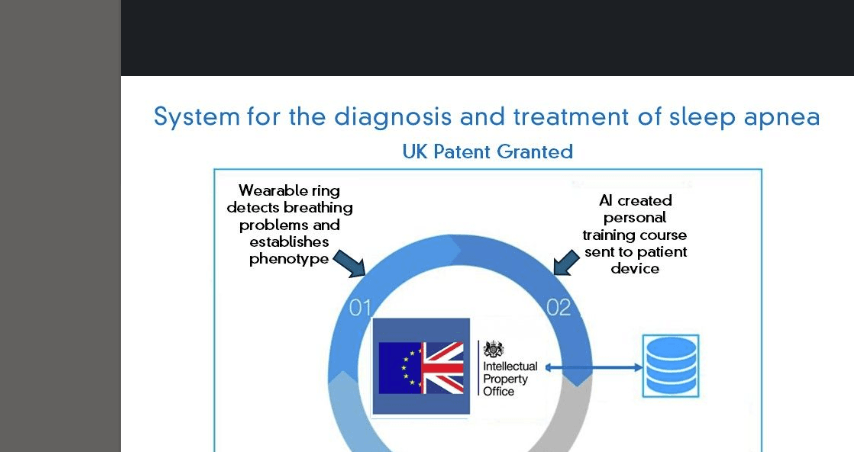
One recently awarded patent covers a closed-loop system that identifies apnea phenotypes and builds personalized training regimens using neuroplastic protocols.
Sleep apnea care is changing fast, and this patent captures where we think it’s heading: away from one-size-fits-all devices and toward support that adapts to the individual.
Congratulations to the development teams at BreatheSimple and our partners Futurice and Bodimetrics, along with the diligent legal work of DLA Piper on being granted another important patent. After many years researching non-invasive ways to alleviate the symptoms of sleep apnea, this grant recognizes several breakthrough innovations.
The patented closed-loop system: a wearable ring detects breathing problems and establishes the phenotype, then delivers a personalized training course. Figure from the BreatheSimple research deck (UK patent granted).
What the patent covers
At its heart, the patent describes a closed-loop system for two connected tasks:
- Determining a sufferer’s sleep apnea phenotype — the underlying reason their breathing destabilizes during sleep.
- Using that result to create a personalized regimen built on neuroplastic protocols — training that works with the nervous system’s ability to adapt over time.
“Closed-loop” is the key phrase. Rather than applying a fixed response and hoping, the system measures, responds, and adjusts — feeding what it learns about a person back into the regimen itself. The patent describes one of many possible embodiments of these inventions, so it’s better understood as a framework than a single product.
This adds to our broad international IP portfolio spanning sleep and breathing science, neuroplasticity, and the application of wearables.
Why neuroplasticity?
For a significant share of apnea sufferers, the problem isn’t only mechanical. An estimated 40% of patients have a neurophysiological root cause triggering their sleep disturbances — instability in how the brain regulates breathing, not just a collapsing airway.
Neuroplastic protocols aim at that root: rather than physically forcing the airway open every night, they train the breathing control system itself. It’s a fundamentally different kind of tool, designed to complement existing care rather than replace it.
The reason a closed loop matters so much here is that adaptation is personal. The pace at which someone’s nervous system responds, the protocol that fits their sleep and their lifestyle — none of it is uniform across sufferers. A system that measures, adjusts, and measures again is far better suited to that reality than a fixed regimen handed out identically to everyone.
A rapidly changing landscape
Both the diagnosis and treatment of sleep apnea are advancing quickly, and these innovations are built to fit that shift:
- Alternatives to CPAP for improving airway patency are steadily gaining market share, giving sufferers more options than just the traditional mask.
- Wearables can screen at scale, helping reach the estimated 80% of apnea sufferers who remain undiagnosed and prompting them to seek help.
- Therapies are increasingly personalized — and even combinatorial, pairing approaches that target different mechanisms at once.
Our work slots into this picture by adding a tool aimed squarely at the neurophysiological side of apnea — the part that airway-focused devices were never designed to address.
Key takeaways
What does “closed-loop” mean here? The system measures a sufferer’s phenotype, designs a training regimen, and adjusts this based on the response — a feedback loop rather than a fixed one-size-fits-all protocol.
What’s a neuroplastic protocol? A training approach that works with the brain’s ability to adapt, aimed at the breathing control system rather than the airway alone.
Who is this for? It’s designed to help the estimated 40% of apnea sufferers with a neurophysiological component to their sleep disturbances — often alongside other treatments.
Is this a cure for sleep apnea? No. It’s an additional, personalized tool within a broader and evolving treatment landscape. BreatheSimple is not a medical device and does not diagnose or treat disease.
The thread connecting it all
What ties this portfolio together is a simple conviction: sleep apnea is often a control-system problem, and control systems can be measured, phenotyped, and trained. Personalized, closed-loop training is how that conviction becomes practical.
That same idea drives BreatheSimple — personalized health for breathing, grounded in how your nervous system regulates each breath. If you’re curious where you stand, our free, patented screening test is a quiet first step.