REM sleep behavior disorder Parkinson's
Could the Way You Sleep Warn You About Parkinson's?
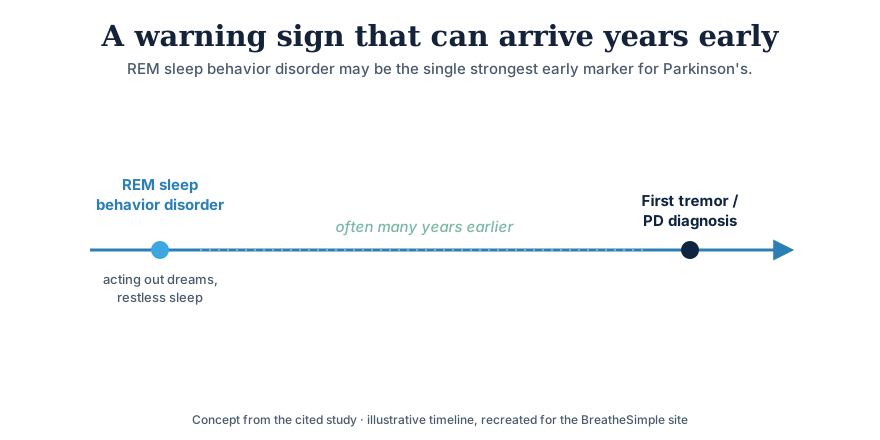
Acting out your dreams may be one of the earliest warning signs of Parkinson's — appearing years before tremors. Sleep is becoming a powerful diagnostic signal.
What if the way you sleep could warn you about Parkinson’s disease — years before the first tremor ever appears? It sounds far-fetched, but it’s exactly what a recent study points toward.
REM sleep behavior disorder can appear years before the first tremor — a potential early-warning window for Parkinson’s. Illustrative timeline based on the cited study.
A surprisingly early warning sign
The work comes from a team at the Shanghai University of Medicine and Health Science, who studied 424 subjects and published their results in Nature. Their central finding is striking: REM sleep behavior disorder — acting out dreams, restless and disrupted sleep — could be the single strongest early marker for Parkinson’s disease.
REM sleep is normally a paralyzed state; your brain runs vivid dreams while your body stays still. In REM sleep behavior disorder, that paralysis fails, and people physically act out what they’re dreaming — talking, kicking, sometimes thrashing. The study suggests this disruption can show up well before the motor symptoms most people associate with Parkinson’s, which is what makes it so valuable. By the time a tremor is visible, the disease has often been underway for years. A signal that arrives earlier — quietly, during sleep — is a signal you can potentially act on sooner.
The researchers didn’t stop at sleep, either. The study also shows a strong connection to gut microbiome dysfunction and metabolic shifts detectable in blood tests, alongside the sleep-pattern trends — a picture of a disease that leaves traces in several systems before it announces itself.
Sleep as a diagnostic signal
This study is one example of a much broader shift. Subtleties in sleep quality, structure, and patterns are becoming some of the most important diagnostic signals in medicine.
That reframes what sleep data is for. We tend to think of sleep tracking as a wellness nicety — a number to glance at over coffee. But trends in sleep patterns may eventually tell your doctor more than a standard annual physical does. The research underscores the value of long-term, low-cost sleep monitoring: not a single measurement, but a record that accumulates over months and years and can reveal a trajectory.
That kind of monitoring is precisely the role we expect wearables and smartphone applications to fill. They are inexpensive, they’re already on or beside us every night, and they can quietly build the kind of longitudinal picture a one-off test never could. A single sleep study tells you about one night; a device you use continuously can reveal how your sleep is changing — and change over time is often where the most important medical information hides.
None of this means a restless night is cause for alarm. The point is subtler and more hopeful: the data we needed to spot early patterns is increasingly within reach, no longer locked inside an expensive overnight lab visit, or even a single night test at home.
Key takeaways
What is REM sleep behavior disorder? It’s a condition where the normal muscle paralysis of REM sleep fails, so a person physically acts out their dreams — often with restless, disrupted sleep.
How is it linked to Parkinson’s? A study of 424 subjects published in Nature suggests REM sleep behavior disorder may be the single strongest early marker for Parkinson’s, sometimes appearing years before tremors.
Does this mean restless sleep predicts Parkinson’s? Not on its own. Disrupted sleep has many causes. The research points to a statistical association worth studying further — it is not a diagnosis, and any concerns should go to a clinician.
Where we fit in
We’ve entered an era where trends in sleep patterns can carry real diagnostic weight — and where the tools to capture those trends are finally cheap enough to use every night.
BreatheSimple is not a medical device and does not diagnose or treat Parkinson’s or any other condition. But it reflects our broader conviction: that low-cost, long-term insight into how you sleep and breathe belongs in everyone’s hands. Stay tuned — and if you’d like to be first to know, join our waitlist.