sleep and running injuries
How Your Sleep Predicts Your Next Running Injury
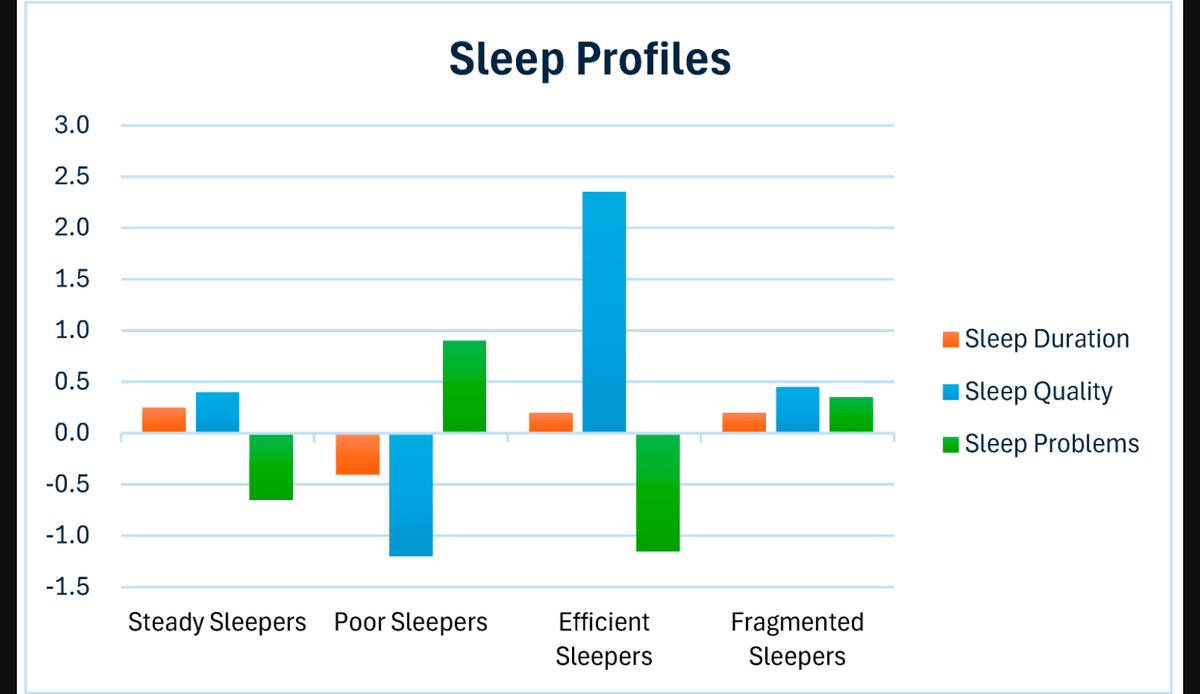
A study of 425 recreational runners found that one specific 'poor sleep' profile carried an 80% chance of injury—a signal your wearable could already detect.
Most runners obsess over pace, mileage, and shoes. Far fewer think of their sleep as a leading indicator of injury. New research suggests they should—and that the wearable already on your wrist may be sitting on the answer.
Sleep profiles among recreational runners across four phenotypes. Source: research cited in this post (De Jonge et al., Applied Sciences).
The market hunting for a real benefit
The consumer wearable market has become fiercely competitive. One of the most targeted segments is recreational runners—over 600 million worldwide, around 50 million in the United States alone. As the category gets more commoditized, any genuine new user benefit could both expand sales and win market share.
Some recent research, led by Prof. Dr. Jan de Jonge at the Eindhoven University of Technology, might just provide that opportunity—and it points at something most wearables already measure.
Four kinds of sleepers
The researchers studied 425 recreational runners and segmented them into four latent sleep profiles, or phenotypes, based on three parameters: sleep duration, sleep quality, and any noted additional sleep problems.
The groups broke down like this:
- Steady — close to 50% of subjects
- Poor — 37%
- Efficient — 8%
- Fragmented — 7%
They then cross-correlated these profiles with each runner’s past history of reported injuries. The results were not what you might expect.
The surprising signal
Only the poor sleep profile showed a clear relationship with injury—and it was a strong one: an 80% chance of injury within a defined timeframe. Shorter “efficient” sleep or “fragmented” sleep did not present the same threat.
That nuance matters. The headline is not simply “sleep less, get hurt.” It is that a specific pattern of poor sleep—low on duration, low on quality, and carrying additional problems—is the one that lines up with injury risk. The body seems to tolerate brief or broken sleep better than it tolerates genuinely poor sleep.
What wearables could do with this
Here is the practical part. Most consumer wearables already derive both running data and sleep data. It would be a relatively easy addition to extract a user’s personal sleep patterns, correlate them with their physical activity, and flag when the combination starts to look risky.
If the analysis projected a heightened chance of injury, the device could alert the user and suggest behavioral changes—an extra rest day, an earlier bedtime, a lighter week. Avoiding a debilitating injury is the kind of benefit a runner would happily pay for.
So, Apple, Fitbit, Garmin, Oura, Samsung, Whoop—who is going to be first to keep your athletic customers out of the ER?
Key takeaways
- Does bad sleep cause running injuries? This study found one specific “poor” sleep profile carried an 80% chance of injury, while “efficient” and “fragmented” sleep did not show the same link. It is an association, not proof of cause.
- What made the “poor” group different? Low sleep duration, low quality, and additional sleep problems together—not just short or broken sleep.
- Can my wearable warn me? Not automatically yet, but most devices already collect the running and sleep data needed to build such an alert.
Where BreatheSimple fits
The takeaway here is that performance and recovery are downstream of how well your body settles at night—and breathing is a big part of how well it settles. BreatheSimple focuses on the control system behind that: how your nervous system regulates breathing, and how stable it stays.
BreatheSimple is not a medical device and does not diagnose or treat injuries. But if you want a simple read on one input to your recovery, our free, patented screening produces a Breathing Control Index in a few minutes using your phone. It is a quiet way to start training the system that helps you rest—and run—better.