sleep apnea night to night variability
Why One Night in a Sleep Lab Isn't Enough
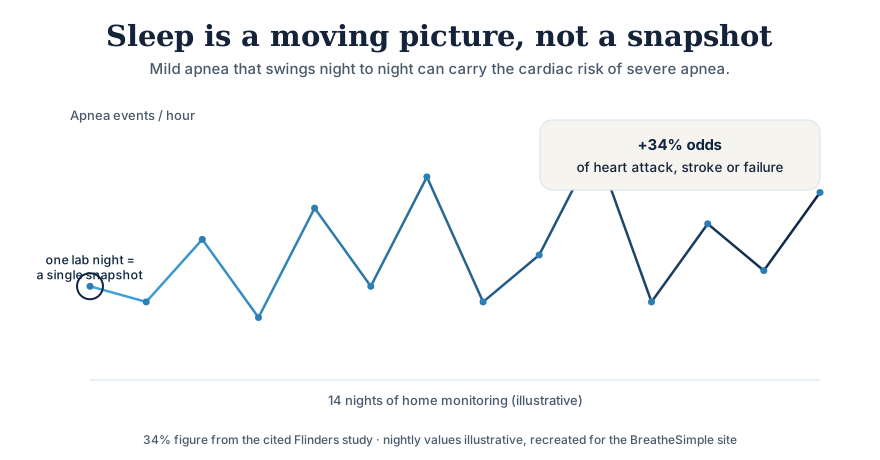
A single night in a sleep lab can't see how much your apnea changes from night to night — yet that variability may predict heart attack and stroke risk.
Here’s an unsettling finding: someone whose sleep apnea is labeled “mild” can carry the same risk of cardiac arrest as someone diagnosed with severe apnea. The difference isn’t how bad any single night looks — it’s how much their apnea varies from night to night. And that is exactly what a single sleep study, in a lab or at home, can never detect.
Apnea severity can swing night to night — something a single lab study cannot see. The most variable group carried 34% higher odds of heart attack, stroke or heart failure. Nightly values illustrative; 34% from the cited study.
The problem in a snapshot
A team led by researchers at Flinders University in Australia tracked over 3,000 adults using under-mattress sensors — not for one night, but for six months. That distinction is the whole point. Most apnea diagnoses rest on a single or at most two nights of measurement, and by definition, can’t reveal how much things change.
What they found is that the variability of apnea events from night to night was an independent predictor of cardiovascular disease. The highest-variability group had a 34% increase in the odds of heart attack, stroke, or heart failure.
The current standard of care — one or two nights in a lab — fundamentally cannot uncover this. Variability is invisible to a single measurement, in the same way you can’t judge a region’s climate from one afternoon’s weather. As team member Dr. Pinilla put it, “sleep should be a moving picture, not a snapshot.”
Why we don’t already do this
If repeated measurement is so revealing, why isn’t it standard? Cost and burden. Fully instrumented sleep diagnoses — whether an overnight stay in a sleep lab or a home sleep apnea test (HSAT) device — are far too expensive and cumbersome to repeat night after night. They were built to be done once.
That leaves an obvious and uncomfortable gap. How many people walked out of a sleep lab with a clean bill of sleep health, only to have a heart attack later — one that a fuller picture of their breathing might have flagged? When you only ever measure once, you don’t just miss the variability; you miss the people whose risk lives in that variability.
Measure it like blood pressure
There’s a useful comparison here. We don’t check blood pressure or blood sugar a single time and call it settled — we track them repeatedly, over time, because the trend is the information. As Professor Eckert, a contributor to the study, notes: “Blood pressure and blood sugar are measured repeatedly over time, and sleep health should be treated the same way.”
This is exactly where low-cost wearables and smartphone apps can play a vital role: not to replace clinical diagnosis, but to screen — to surface longer-term trends and night-to-night variability in sleep behavior that no one-off test will ever see.
Key takeaways
Why isn’t one sleep study enough? A single night can’t capture how much your apnea changes from night to night — and that variability was found to independently predict cardiovascular risk.
What did the study find? Tracking over 3,000 adults for six months, researchers found the highest night-to-night variability group had 34% higher odds of heart attack, stroke, or heart failure.
How should sleep be monitored instead? Like blood pressure or blood sugar — repeatedly, over time. Long-term, low-cost screening can reveal trends a single measurement misses.
Toward prevention, not just treatment
This is one of the core reasons our team is building low-cost screening systems: to shift the emphasis from treating chronic disease after the fact to catching the warning signs early. Sleep deserves to be measured the way we measure other vital trends — repeatedly, affordably, over time.
BreatheSimple is not a medical device and does not diagnose or treat sleep apnea or cardiovascular disease; those conversations belong with your clinician. But our free, patented screening test is a simple first look at your own breathing — a snapshot today, with much more to come.