sleep apnea and Parkinson's
Untreated Sleep Apnea and the Risk of Parkinson's
A massive veterans' study links untreated sleep apnea to a meaningfully higher risk of Parkinson's—and finds that earlier treatment offers real protection.
We tend to think of sleep apnea as a daytime-tiredness problem. A new study of more than 11 million US veterans suggests the stakes run deeper—and that what happens to your brain across years of disrupted breathing may help explain who is more likely to develop Parkinson’s.
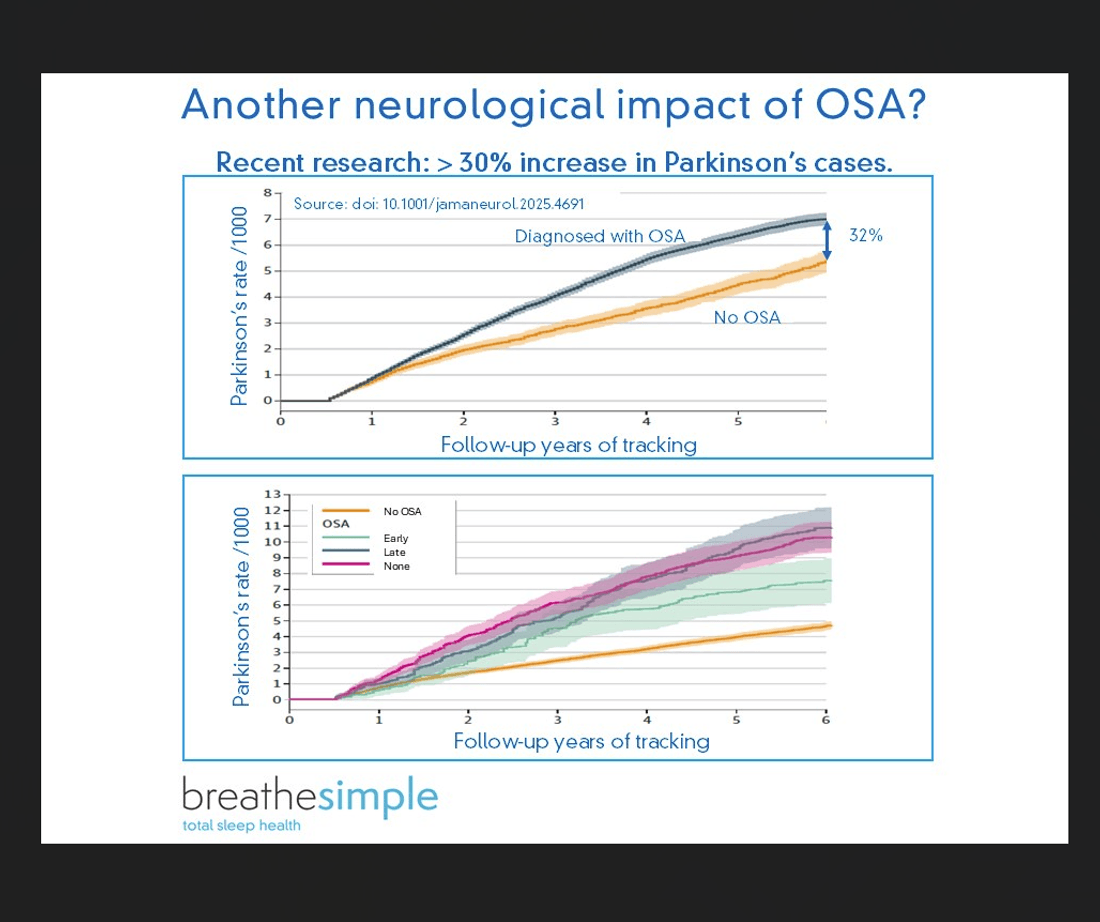
BreatheSimple’s read on the VA veterans’ data: an OSA diagnosis tracked with a higher Parkinson’s rate over years of follow-up (top), while earlier OSA treatment was associated with lower risk (bottom). Figure from the BreatheSimple research deck, based on the cited JAMA Neurology study.
A disease of lost dopamine
Parkinson’s is the second-most common neuro-degenerative disease after Alzheimer’s. It affects nearly 2 people per 1,000 globally, about half of them over 60, and an estimated 1.1 million people in the U.S. alone are living with it.
Symptoms develop when dopamine-producing brain cells die, disrupting the ability to control movement. Other parts of the brain can be affected too, leading to mood changes, sleep problems, and cognitive impairment. It is a slow, costly disease—hard on patients and heavy on the caregivers and supporting health systems.
What the veterans’ data showed
An important study, led by Drs. Neilson and Scott from the VA Portland Health Care System, analyzed health records from more than 11 million U.S. military veterans over the period 1999–2022. The findings are striking:
- Subjects diagnosed with sleep apnea were over 30% more likely to develop Parkinson’s over just a few years.
- Among those with sleep apnea, individuals who did not undertake therapy for their obstructive sleep apnea (OSA) had nearly twice the likelihood of developing Parkinson’s compared with those who sought treatment.
- The earlier treatment was administered after diagnosis, the greater the protection against Parkinson’s onset.
In other words, leaving OSA untreated is associated with a meaningfully higher risk—and improving sleep quality appears to lower it.
Why breathing and the brain are linked
The mechanism is intuitive once you see it. Co-author Dr. Neilson put it plainly: “If you stop breathing and oxygen is not at a normal level, your neurons are probably not functioning at a normal level either… add that up night after night, year after year, and it may explain why fixing the problem early on may build in some resilience against neurodegenerative conditions, including Parkinson’s.”
The emerging picture is that sleep apnea causing significant, extended drops in blood oxygen can contribute to neurodegenerative processes in the brain—associated with the onset of both Alzheimer’s and Parkinson’s. Each night of oxygen dips is small. The accumulated impact, over years, may not be.
The screening gap
Here is the frustrating part. Despite decades of effort, we still find and treat only about 20% of apnea sufferers. The other 80% are, in effect, undiagnosed.
Several low-cost wearables can finely track dangerous drops in blood oxygen concentration during sleep. They could be used to screen for apnea events—and arguably do better than leaning on AHI (the apnea-hypopnea index), a marker that has long been an inadequate summary of overnight breathing. If the risk on the table is this serious, sticking with the old approach is hard to justify. It is surely time to do something different and better.
Key takeaways
- Does untreated sleep apnea raise Parkinson’s risk? In this large veterans’ study, having sleep apnea was associated with over 30% higher odds of developing Parkinson’s, and leaving it untreated nearly doubled the risk versus those who sought treatment.
- Does treatment help? Yes—and timing matters. Earlier treatment after diagnosis was associated with greater protection.
- Why are so many cases missed? Only about 20% of apnea sufferers are currently found and treated. Better screening tools could close that gap.
Where BreatheSimple fits
This study is a reminder that breathing during sleep is not a side issue—it is central to long-term brain and body health. BreatheSimple is built around the same idea: that how your nervous system regulates breathing is worth measuring and, where helpful, training.
BreatheSimple is not a medical device and does not diagnose or treat sleep apnea, Parkinson’s, or any other condition—if you suspect apnea, talk to a clinician. But getting curious about your breathing is a sensible first step. Our free, patented screening produces a Breathing Control Index in a few minutes using your phone, and passive overnight sleep-instability measurement is on our roadmap. Join the waitlist to be first to try it.
Full study published in JAMA Neurology (2025).