sleep regularity and mortality
Sleep Regularity Beats Sleep Duration for Longevity
A large UK Biobank study found that consistency of sleep timing predicts mortality risk better than how long you sleep. Why regularity may be the better target.
We’ve all absorbed the message that keeping a regular sleep pattern matters, and that sleeping too little or too much may be bad for us. But which of those two factors — consistency or duration — actually moves the needle on how long we live? This large new study offers a surprising answer.
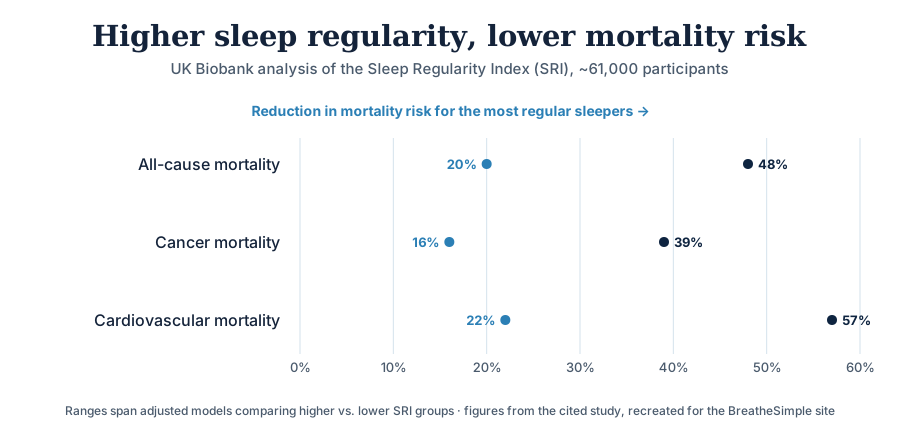
Across adjusted models, the most regular sleepers showed substantially lower mortality risk. Chart recreated as an original BreatheSimple graphic from the figures in the cited study.
Regularity, not duration
An international team from Monash and Manchester Universities and Brigham and Women’s Hospital in Boston set out to untangle how sleep timing and sleep length each affect life expectancy. Their conclusion was striking: sleep regularity is a stronger predictor of mortality risk than sleep duration.
The researchers analyzed Sleep Regularity Index (SRI) scores from nearly 61,000 participants in the UK Biobank, then tracked mortality over the following years — with 1,859 deaths recorded across a follow-up period spanning roughly 7.8 years.
What is the Sleep Regularity Index?
SRI is a measure of how predictable your sleep is. It’s calculated from the probability that you’re asleep (or awake) at the same clock times from one 24-hour period to the next. The more your sleep and wake times line up day after day, the higher your score. A high SRI means a consistent rhythm; a low SRI means your sleep wanders all over the clock.
The size of the effect
The associations were large enough to take seriously:
- Higher SRI was linked to a 20%–48% lower risk of overall mortality.
- A 16%–39% lower risk of death from cancer.
- A 22%–57% lower risk of death from heart attacks and stroke.
Put more vividly: across the study’s roughly eight-year window, the mortality rate for irregular sleepers was close to double that of regular sleepers. Same number of hours, very different outcomes — depending on whether those hours arrived on a dependable schedule.
The takeaway the authors draw is refreshingly practical: sleep regularity may be a simple, effective target for improving general health and long-term survival. You don’t necessarily need to sleep more — you may benefit most from sleeping on a steadier schedule.
Why this is good news for wearables
SRI is a relatively simple metric to compute from any of the existing 24-hour wearable trackers people already own. It mostly needs to know when you’re asleep — not the harder, noisier question of which sleep stage you’re in.
That matters, because consumer sleep-stage tracking is notoriously imprecise. A regularity score sidesteps that problem entirely. It may turn out to be a far more valuable long-term health marker than questionable sleep-stage estimates — and it’s already within reach of the hardware on millions of wrists or fingers.
It’s a nice example of a broader pattern: the most useful health signal isn’t always the most complicated one. Sometimes it’s the simple, robust measure you can actually trust.
Key takeaways
What matters more — how long I sleep, or when? In this study, when won. Regularity of sleep timing predicted mortality risk more strongly than total sleep duration.
What is a good Sleep Regularity Index? Higher is better. SRI rises the more consistently you fall asleep and wake at the same times each day. The study tied higher SRI to substantially lower mortality risk.
Can my wearable measure this? Likely yes. SRI can be derived from standard 24-hour wearable tracking and doesn’t depend on hard-to-measure sleep stages, making it a robust and accessible target.
Where BreatheSimple fits
Regularity is a reminder that the body runs on rhythms — and breathing is one of the most fundamental. BreatheSimple focuses on how your nervous system regulates breathing, including the kind of overnight breathing instability that fragments otherwise consistent sleep. Our free, patented screening reads your breathing in just a few minutes, and passive overnight sleep-instability measurement is on our roadmap.
If you’re working on a steadier night, it’s worth understanding the breathing underneath it. Join the waitlist to try the screening when it opens.
Source: UK Biobank Sleep Regularity Index study (Monash, Manchester, and Brigham and Women’s Hospital). BreatheSimple is not a medical device and does not diagnose or treat any condition.