apnea-hypopnea index
Why AHI Fails to Predict Sleep Apnea Risk
For decades, sleep apnea has been graded with a single number. A new AI study from Cleveland Clinic and IBM shows how much that number misses.
For decades, sleep apnea has been measured with one number: the apnea-hypopnea index (AHI), a count of breathing pauses and shallow breaths per hour of sleep. Cleveland Clinic and IBM have now shown how poorly that number predicts who will develop chronic cardiovascular or neurological disease, or who may die early.
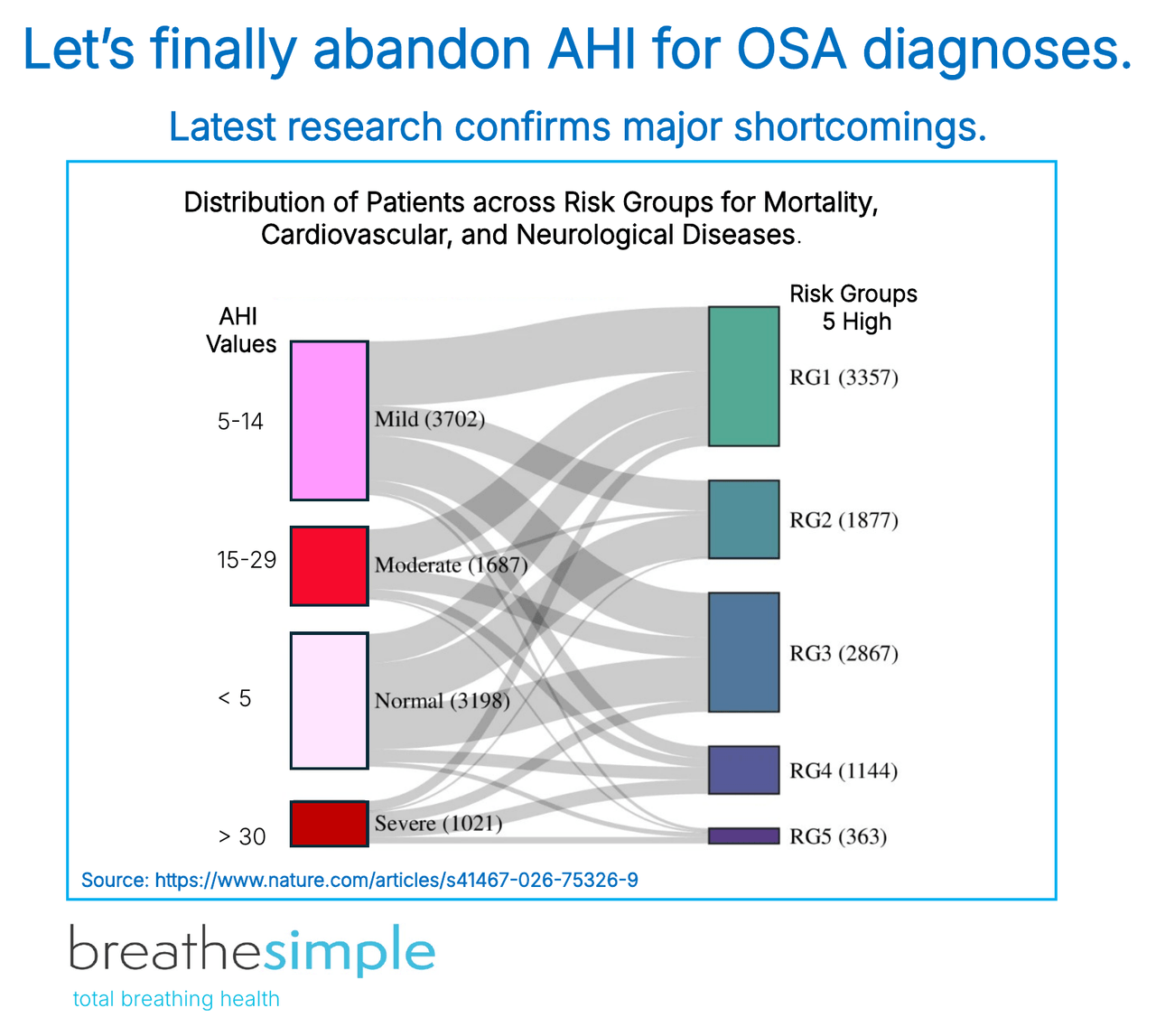
Patients in every AHI category, from normal to severe (left), are spread across all five risk groups found by the AI model (right). Figure from Bilal et al., Nature Communications (2026), CC BY 4.0.
The information was in the raw data
The team built an AI foundation model and trained it on more than 10,000 clinical sleep studies linked to patients’ medical records. The model reads the full, continuous overnight signal and sorted patients into five risk groups. The results were published in Nature Communications.
- The highest-risk group had more than double the risk of death of the lowest-risk group.
- That group also had higher risk of atrial fibrillation, cognitive impairment, heart attack and heart failure.
- AHI severity categories showed little or no predictive value. Patients with severe AHI landed in several risk groups, and the highest-risk group included patients from every AHI category, normal included.
- The approach held up in an independent population, the Sleep Heart Health Study, and found risk in both men and women. Earlier AHI-based analyses of that study had linked apnea to mortality mainly in men.
Why this matters for patients
A reassuring AHI can tell a patient and their physician there is nothing to worry about while the full recording shows real risk. That can be highly misleading, even dangerous. Overall, the study found little relationship between AHI values and health risk.
Beyond a single number
The lesson is profound. We have been reducing a rich, complex physiological signal to a single number and throwing away most of the information in the process. The future of sleep health lies in the microstructure: the moment-to-moment patterns that summary scores hide, which we call dynamic microdata (DMD). The whole field is moving in this direction. Measuring sleep well matters far more than measuring it simply.
We think it is time to stop treating AHI as a serious measure of risk. This is where our own research and advanced product development is focused, and we will have more to share soon. For more on what AI can read from a night of sleep, see Can AI Predict Disease From a Night’s Sleep?.
Key takeaways
What is AHI? The apnea-hypopnea index counts breathing pauses and shallow breaths per hour of sleep. It has been the standard measure of sleep apnea severity for decades.
What did the Cleveland Clinic and IBM study find? An AI model reading the full sleep signal found five risk groups. The highest-risk group had more than double the risk of death of the lowest, while AHI categories showed little predictive value.
Should I ignore my AHI result? No. AHI is still the standard for diagnosing sleep apnea and guiding treatment, so discuss your results with your clinician. This research shows it is an incomplete measure of long-term risk.
What is dynamic microdata? Our term for the moment-to-moment structure of breathing and sleep signals, the detail that a single nightly average hides.
Where BreatheSimple fits
BreatheSimple is built around dynamic breathing microdata. Our free screening uses your phone’s microphone to measure how your nervous system regulates breathing and gives you a Breathing Control Index in a few minutes. BreatheSimple is a wellness and screening tool, not a medical device, and it does not diagnose or treat any condition. Join the waitlist to hear about our next announcements first.
Full study: Bilal et al., A foundation model for sleep-based risk stratification and clinical outcomes, Nature Communications (2026). doi:10.1038/s41467-026-75326-9