sleep apnea and atrial fibrillation
Sleep Apnea and AFib: A Link Too Often Missed
Up to 8 in 10 people with atrial fibrillation may have sleep apnea, and most don't know it. A new Finnish study adds to the evidence.
A new study from Turku, Finland, prompted us to revisit the wider research on sleep apnea and atrial fibrillation (AFib). Up to 8 in 10 people with AFib may have sleep apnea, and most are unaware of it. The link between sleep-disordered breathing (SDB) and heart rhythm problems remains badly under-recognized.
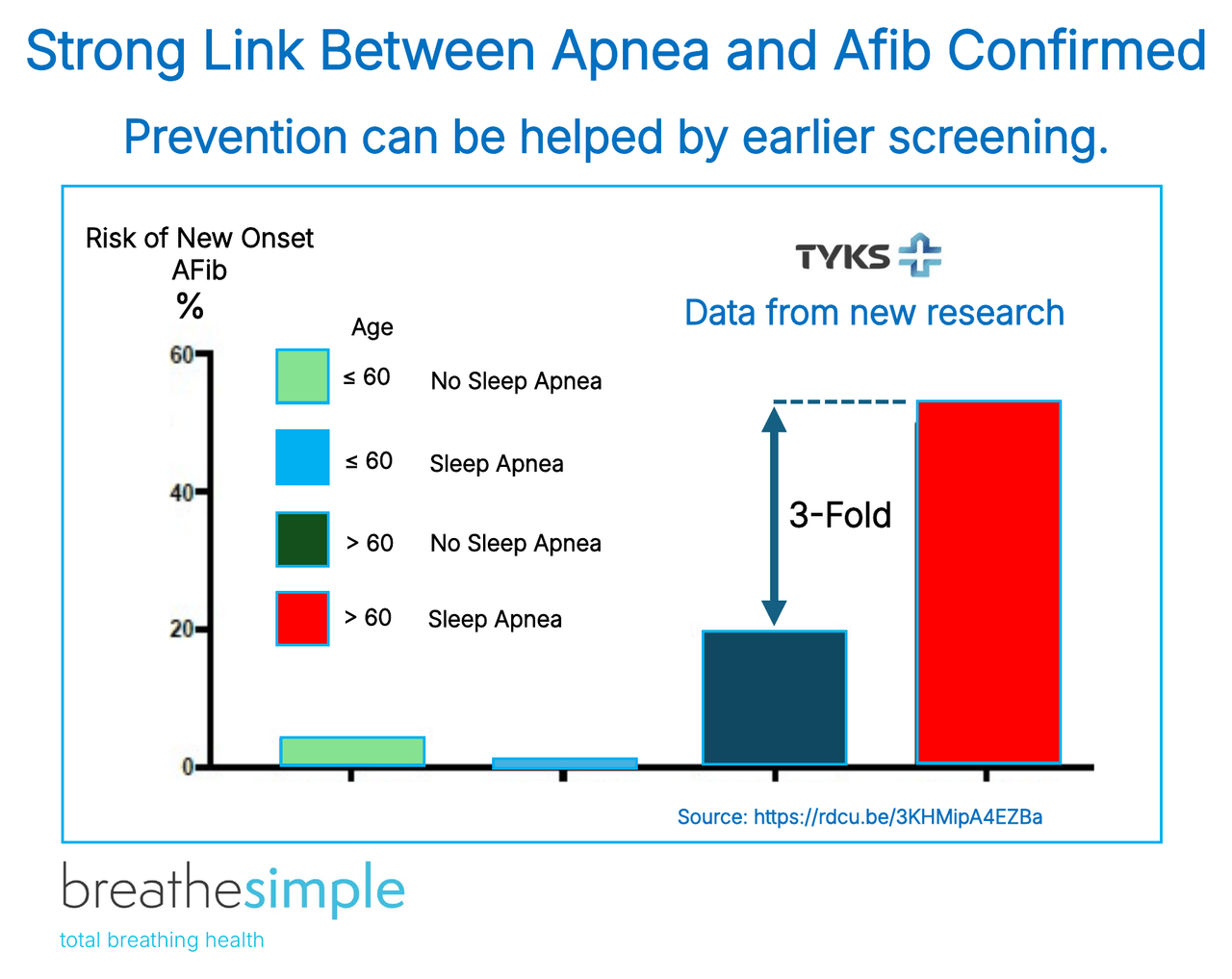
Risk of new-onset AFib in peritoneal dialysis patients, by age and sleep apnea. Over 60, about half of those with sleep apnea developed AFib, roughly three times the rate in those without. BreatheSimple chart of data from Virtanen et al., BMC Nephrology (2026).
The Finnish findings
The team at Turku University Hospital followed patients on maintenance peritoneal dialysis, a home-based treatment for kidney failure. Sleep apnea was independently associated with roughly three times the risk of developing AFib. In patients over 60, the risk rose to about 5.5 times. In that older group, about half of the patients with sleep apnea developed AFib.
What the wider research shows
AFib is the most common serious heart rhythm disorder and a leading cause of stroke. A growing body of evidence ties it directly to sleep-disordered breathing.
- Across multiple cohort studies, sleep apnea raises the risk of developing AFib by roughly 70 to 100 percent, and the risk climbs with severity.
- Among people who already have AFib, studies find sleep apnea in anywhere from a fifth to three-quarters of patients. In one study of AFib patients with no prior apnea diagnosis, 82 percent tested positive.
- Treating apnea with CPAP has been shown to cut AFib recurrence by around 40 percent, with long-term treatment reducing late recurrence much further.
Most of these patients have no idea of the longer-term risk they face, or how long they have had disordered breathing.
How apnea strains the heart
The mechanism is well understood. Each pause in breathing during sleep drops blood oxygen and jolts the central nervous system awake. Over time, these stresses may gradually remodel the heart’s upper chambers, creating the conditions for AFib.
The step that gets skipped
Early sleep apnea is easy to miss because its symptoms are usually subtle. Yet that early stage is exactly when preventive steps can do the most good, and it is when screening is most often skipped. If every AFib patient were checked for disordered breathing as a matter of course, we could change outcomes and save lives. We explain why apnea is more than an airway problem in Beyond the Airway.
Key takeaways
Is sleep apnea linked to AFib? Yes. Cohort studies find that sleep apnea raises the risk of developing AFib by roughly 70 to 100 percent, and the new Finnish study found about three times the risk in dialysis patients.
How common is sleep apnea in people with AFib? Studies report it in a fifth to three-quarters of AFib patients. In one study of AFib patients never tested before, 82 percent had it.
Can treating sleep apnea help? CPAP treatment has been shown to cut AFib recurrence by around 40 percent.
Who should be screened? We believe everyone with AFib should be checked for sleep-disordered breathing. Talk with your clinician about testing.
Where BreatheSimple fits
Screening is the step most often missed. BreatheSimple’s free screening uses your phone’s microphone to give you a Breathing Control Index in a few minutes, a simple first look at how your nervous system regulates breathing. BreatheSimple is a wellness and screening tool, not a medical device, and it does not diagnose or treat sleep apnea, AFib or any other condition. Join the waitlist to be among the first to try it.
Full study: Virtanen et al., Sleep apnea is associated with new-onset atrial fibrillation in patients undergoing peritoneal dialysis, BMC Nephrology (2026). doi:10.1186/s12882-026-05293-2