sleep apnea and immune system
Sleep Apnea May Weaken Your Body's First Line of Defense
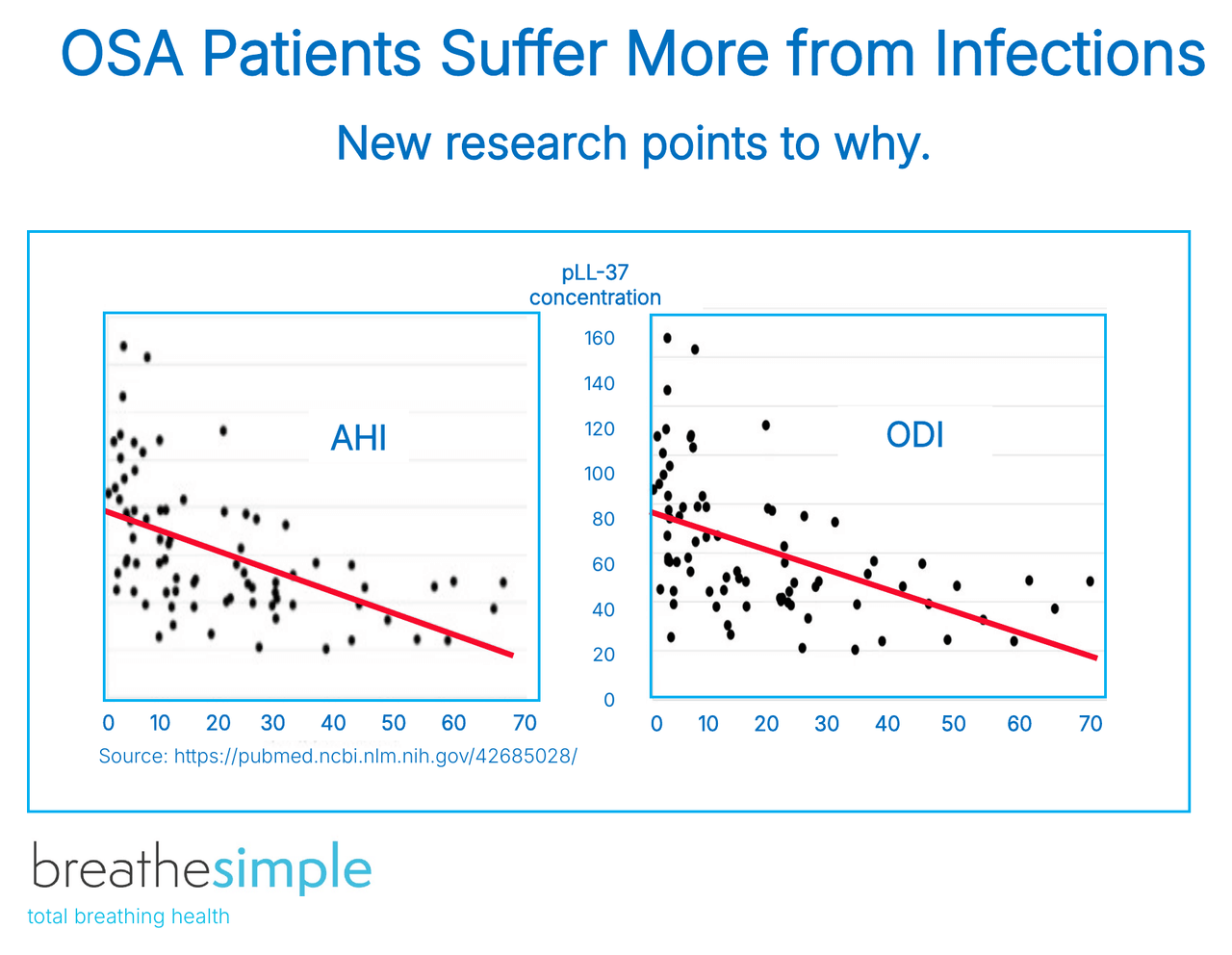
People with sleep apnea get more respiratory infections and may recover more slowly. A new study of a key immune molecule, LL-37, offers a clue why.
Research, including work from the University of Minnesota, has shown that people with sleep apnea are at higher risk of respiratory infections, including influenza and COVID-19, and may recover more slowly. The usual explanation points to immune changes and chronic inflammation caused by obstructive sleep apnea (OSA). A new study offers a more specific clue.
Plasma LL-37 falls as sleep apnea gets worse, whether measured by AHI or ODI. Chart of data from Yamaguchi et al., PLOS ONE (2026), CC BY 4.0.
A key immune molecule runs low
Researchers at Iwate Medical University in Japan measured LL-37 in the blood. LL-37 is a natural antimicrobial peptide, part of the innate immune system that forms the body’s first line of defense against bacteria and viruses.
The study included 78 men who came to a sleep clinic with snoring and suspected sleep apnea. After an overnight sleep study, 58 were diagnosed with OSA and 20 were not. LL-37 levels dropped as apnea got worse. Men with moderate to severe apnea (an AHI of 15 or more) averaged 47.1 ng/L, compared with 75.3 ng/L in those with mild or no apnea.
The charts show this pattern for two common sleep apnea markers. AHI (apnea-hypopnea index) counts breathing pauses and shallow breaths per hour of sleep. ODI (oxygen desaturation index) counts drops in blood oxygen per hour. LL-37 also tracked sleep quality: it was higher with more deep and REM sleep, and lower with more light sleep and more awakenings.
Why oxygen drops may matter
The likely driver is intermittent hypoxia, the repeated dips in oxygen that happen each time breathing stops during sleep. Those dips fuel inflammation and oxidative stress throughout the body, which can disrupt immune signaling and make the immune system less effective.
What the study can and can’t tell us
The sample was small and included only men. The study was observational, so it can show an association but cannot prove that apnea causes LL-37 to fall. Blood was drawn once, in the morning.
The bigger picture
OSA is already linked to harm in the cardiovascular, nervous and metabolic systems. We have written about its link to Parkinson’s disease. This study adds the immune system to the list.
Sleep-disordered breathing reaches well beyond the bedroom and daytime tiredness. Night after night, it affects the entire body, possibly including how well it fights infection. And because it so often goes undiagnosed, many people carry this hidden burden without knowing it. How well you sleep may quietly shape how well your body defends itself through the day. That is another reason to make sleep apnea screening part of routine health care, a step toward preventive medicine.
Key takeaways
Does sleep apnea affect the immune system? People with OSA have higher rates of respiratory infection. This new study found lower levels of LL-37, an immune defense molecule, in men with more severe apnea.
What is LL-37? A natural antimicrobial peptide that is part of the body’s first line of immune defense.
Does this prove sleep apnea weakens immunity? No. The study was small, included only men and was observational, so it shows an association and not cause and effect.
What might explain the link? Repeated oxygen drops during sleep promote inflammation and oxidative stress, which can disrupt immune signaling.
Where BreatheSimple fits
Sleep apnea often goes unnoticed for years. BreatheSimple’s free screening uses your phone’s microphone to give you a Breathing Control Index in a few minutes, a simple first look at how your nervous system regulates breathing. BreatheSimple is a wellness and screening tool, not a medical device, and it does not diagnose or treat any condition. If you think you may have sleep apnea, talk with a clinician. Join the waitlist to be among the first to try the screening.
Full study: Yamaguchi et al., Plasma levels of antimicrobial peptide LL-37 as a biomarker of sleep quality in patients with obstructive sleep apnea: A clinical observational study, PLOS ONE (2026). doi:10.1371/journal.pone.0355855