what is neuroplasticity
The Science of Neuroplasticity: Rewiring How You Breathe
Your brain rewires itself in response to how you use it. Here's what neuroplasticity means — and how it lets you retrain the control system behind steadier breathing.
Your brain isn’t a static machine. It’s adaptive, flexible, and constantly rewiring itself. That ability to change and grow has a name — neuroplasticity — and it’s the reason you can keep learning, recovering, and forming new habits throughout your life.
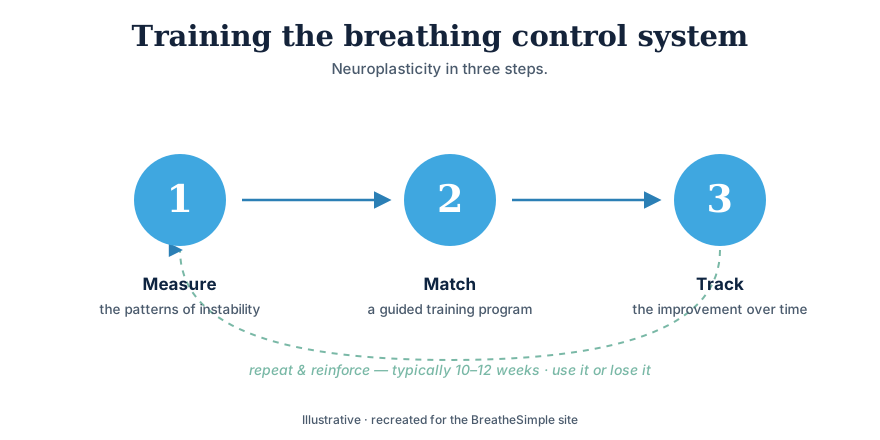
How breathing training works in three steps — measure, match, track — repeated and reinforced, typically over 10–12 weeks. Illustrative.
We can actually watch the brain change
Neuroplasticity isn’t just a metaphor. Brain imaging lets us see where, and to what extent, physical change happens as we modify our behavior. Learning a city’s layout, playing a piece of music, speaking a second language, practicing mindfulness, even cramming for an exam — each one reshapes the brain. In every case, the specific regions tied to that activity expand and rewire; navigation or language centers can measurably grow.
And here’s the part that matters for us: the brain’s breathing control centers are ripe for exactly this kind of change. Here’s how.
Your breathing has two control centers
Breathing control in humans has an unusual history. Like all mammals, our breath is governed automatically by specialized regions near the “primitive” brainstem. These quietly modify our breathing to keep the body in balance when we’re awake and, most importantly, as we sleep. Our breathing shifts when we’re anxious, when we exercise, when we dive — even when we dream.
That arrangement was fine, until we started to talk to one another. Anthropologists trace the arrival of language skills to roughly 100,000 years ago, and two things changed. Mechanically, the mouth, tongue, and throat evolved to produce far more than mere grunts.
Our brain changed too. As language grew more complex, breathing control had to evolve, and an “on-demand” control center developed in the “modern” cortex at the top of the brain — the one that lets us sing, hold our breath, and string together those famously long German words and sentences.
We tell that evolutionary story in more depth in How Your Brain Controls Every Breath You Take.
Training the automatic system
The key insight is that these two control centers — the automatic one near the brainstem and the on-demand one in the cortex — interact. That intra-brain connection is the doorway: it’s how we can use deliberate, guided practice to influence the automatic system when it starts to show signs of instability.
The approach is straightforward in principle:
- Measure the precise patterns of instability in your breathing control.
- Match a guided training program to those specific patterns.
- Track the improvements over time, and reinforce them.
Like most neuroplastic change, it isn’t instant. Meaningful rewiring typically takes around 10–12 weeks to take full effect, followed by the occasional top-up. Because the golden rule of neuroplasticity is use it or lose it — as any musician or second-language speaker will happily confirm.
Key takeaways
What is neuroplasticity? It’s the brain’s ability to physically rewire itself in response to how you use it — strengthening the circuits behind the activities you practice.
Can you really train breathing control? The automatic and on-demand breathing centers interact, so guided practice can help nudge an unstable control system toward steadier behavior over time.
How long does it take? Neuroplastic change is gradual — typically on the order of 10–12 weeks, with occasional reinforcement to maintain it.
Why this matters
Understanding this science has been the focus of our team’s research for years, and it’s what makes BreatheSimple’s approach different. Rather than managing your breathing from the outside every single night, the goal is to help retrain the system that controls it.
BreatheSimple is a wellness and screening tool, not a medical device, and it doesn’t diagnose or treat any condition. But if your breathing control could be calmer and steadier, neuroplasticity is the reason that’s a goal worth pursuing — and our free, patented screening is a simple place to start. See the science or join the waitlist.