brainstem and breathing
The Oldest Part of Your Brain Runs Your Breathing
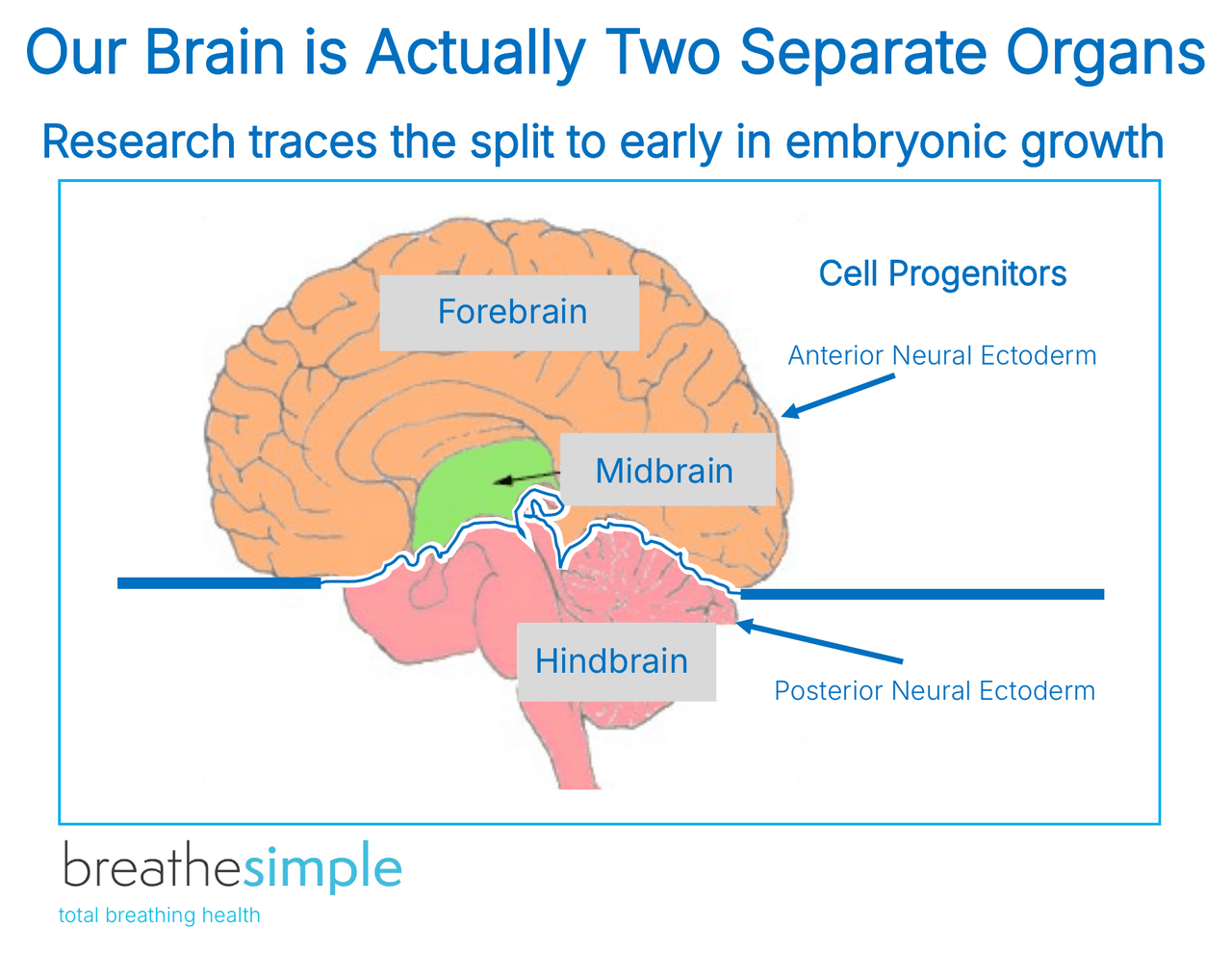
A Stanford study shows the front and back of the brain come from two cell lineages that never mix. The older one keeps you breathing every night.
For centuries we have thought of the brain as a single organ that grows from a single starting point. A study from Stanford Medicine, published in Nature Neuroscience in September 2026, shows it starts out as two.
The forebrain and midbrain grow from one set of progenitor cells (anterior neural ectoderm), the hindbrain from another (posterior neural ectoderm). BreatheSimple diagram based on the Stanford study.
Two starting populations of cells
The team, led by Kyle Loh, followed brain development in mouse embryos. They found two separate pools of progenitor cells. One, marked by the gene Otx2, builds the forebrain and midbrain. That is the part responsible for language, reasoning and most of what we think of as distinctly human. The other, marked by Gbx2, builds the hindbrain, which grows into the brain stem and cerebellum. The two populations never mix.
The researchers found the same two-part pattern in chickens, zebrafish and acorn worms, small animals that live on the ocean floor. The split traces back at least 550 million years. Their reading is that evolution took two existing nervous systems and, over hundreds of millions of years, packaged them together into what we now call one brain.
The older system keeps us alive
The hindbrain is home to the body’s automatic controls. Groups of neurons in the brain stem set the rhythm of every breath, adjust it to the oxygen and carbon dioxide in the blood, and keep it going while we sleep. The brain stem also helps regulate heart rate and the shift between sleep and waking.
So the functions that keep us alive run on the oldest, most conserved system we have, one that predates thought itself. Breath and sleep sit at the foundation. Everything else we think of as human was built on top of them.
Why this caught our attention
This research created a buzz in our own development team. Breathing has two controllers: an automatic one in the brain stem, and a voluntary one in the cortex that lets you hold your breath, sing or speak. We describe both in How Your Brain Controls Every Breath You Take. The two interact, and that interaction is what makes breathing trainable through neuroplasticity. We focus on how different parts of the brain work together to improve breathing control during sleep, so any research that clarifies how the brain is built is central to our work.
We spend enormous energy optimizing the new brain: its focus, its productivity, its output. The ancient one quietly keeps us alive every night. Maybe it deserves more of our attention.
Key takeaways
What did the Stanford study find? In mouse embryos, the forebrain and midbrain grew from one population of progenitor cells and the hindbrain from another, and the two never mixed. The same pattern showed up in chickens, zebrafish and acorn worms.
What does the hindbrain do? It develops into the brain stem and cerebellum. The brain stem runs automatic functions, including the rhythm of breathing during sleep.
Why does this matter for breathing? Automatic breathing is run by the older system, with a newer voluntary system layered on top. Understanding how the two are built helps explain how training one can influence the other.
Where BreatheSimple fits
BreatheSimple measures and trains the control system behind breathing, the part of the brain that keeps working while you sleep. Our free screening uses your phone’s microphone to produce a Breathing Control Index in a few minutes. BreatheSimple is a wellness and screening tool, not a medical device, and it does not diagnose or treat any condition. Join the waitlist to be among the first to try it.
Full study: Jokhai, Dundes et al., Two parallel neural ectoderm progenitors contribute to the developing brain, Nature Neuroscience (2026). doi:10.1038/s41593-026-02433-7